May-Jun 2026 Portfolio Update: The Core Gap Narrows Again

May and June were not spectacular months, and that is probably why I liked them.

The portfolio moved forward in the way I want it to move forward: more capital deployed, more dividends collected, one small speculative position cleaned up, and, most importantly, the Core gap narrowed again.

By the end of June, the Atrahasis Portfolio closed at S$3,287,709.78. Including the Bridge Cash Bucket, total assets stood at S$3,452,709.78. Across the two months, S$51.4k was deployed, S$11.3k of dividends came in, and market movement added about S$119.2k, or roughly 3.8% on the starting balance.

The main story is not that the portfolio went up. The main story is that it became slightly more like the portfolio I am trying to build.

Core is still only about 13.5% against a long-term target of 40%. But when I started tracking the Atrahasis Portfolio in October 2025, Core was around 10.2%. The gap has narrowed by roughly 3.3 percentage points. Slow, yes. But visible.

For new readers: I think of the portfolio in sleeves. Core is the long-term global equity foundation, mainly IWDA. Country Tilts are more targeted positions, largely Singapore income holdings. AAA sits in the AUD cash and income sleeve. The Bridge Cash Bucket is a separate cash buffer designed to reduce sequence-risk and emotional pressure.

Atrahasis Portfolio Key Numbers (1 May to 30 Jun 2026)

Period return3.8%Excludes net contributions
Starting portfolio balance, 1 MayS$3,122,993.74Excludes Bridge Cash Bucket
PurchasesS$51,445.92Fresh capital deployed
Sales proceedsS$5,895.40Mainly NAK exit
Market movement+S$119,165.52Excluding net contributions
Dividends receivedS$11,324.96May and June combined
Ending portfolio balance, 30 JunS$3,287,709.78Final June close
Bridge Cash BucketS$165,000 / S$420,00039% funded
Dividend tapS$4,536.30 / month90.7% of target
Total including BCBS$3,452,709.78Portfolio plus cash buffer

I separate the Bridge Cash Bucket from the invested portfolio because it serves a different job: stability, not growth.

Interactive chart

Portfolio value by month

Portfolio value from October 2025 through the June 2026 close. This excludes the Bridge Cash Bucket.

Selected month
Jun 2026
S$3.288m
+S$438.9k since Oct 2025
Latest monthly change: +S$25.6k.
Interactive chart

Core gap progress

The important movement is allocation progress: Core is still below target, but the gap has narrowed.

Gap closed~3.3 percentage points
June 2026 close: Core is now about 13.5%. That is still early, but it has closed roughly 3.3 percentage points of allocation gap since the Atrahasis Portfolio inception in October 2025.
Interactive chart

May-Jun buying mix

Most buying still went into active tilts, but Core received a meaningful slice of the new money.

Country Tilts took the largest share of May-Jun purchases at about 68.6%, mainly through fresh exposure where valuation or portfolio balance still looked interesting.

May-Jun Purchases

HoldingUnitsApprox amountSleeve
CapitaLand Ascendas REIT / A17U5,900S$14,559Country Tilts
IWDA70~S$12.8kCore
NetLink NBN Trust / CJLU17,000S$16,806Country Tilts
Parkway Life REIT / C2PU1,000S$3,926Country Tilts
AAA56~S$2.4kAUD FX
Bitcoin / BTC-USD0.009994 BTC~S$1.0kAlternatives
TotalS$51,445.92

The buying mix was not perfectly aligned with the long-term target. Core is the biggest strategic gap, but most of the May-Jun buying still went into Singapore income holdings. That reflects the ongoing tension in this portfolio: local income names are familiar, cash-generative, and easier to buy when they look reasonably valued. Core, however, is where the structural rebuild needs to happen. I am comfortable with the specific purchases, but I do not want the comfort of income holdings to slow down the Core buildout.

May-Jun Sales

HoldingUnits soldApprox SGD resultNote
Northern Dynasty Minerals / NAK2,250~S$5.9k proceeds; ~S$1.4k gain (+31.6%)Legacy/speculative cleanup with a positive exit

I fully exited NAK during May and June: 2,250 shares sold for about S$5.9k of proceeds. On my SGD tracking basis, that was roughly S$1.4k of realized gain, or about +31.6% on cost.

This was still a legacy/speculative cleanup, not a major allocation decision. But it is useful to record that the cleanup was done with a positive exit. Net capital deployed into markets after purchases and the sale was about S$45.6k.

The Main Story: Small Steps, Real Progress

Across May and June, the portfolio increased from S$3,122,993.74 to S$3,287,709.78.

That headline increase of about S$164.7k includes fresh purchases. I treat market movement as the change in portfolio value after adjusting for purchases and sales. On that basis, the portfolio added about +S$119.2k, or roughly +3.8% on the starting balance.

Dividends are included in the portfolio accounting, but I track them separately because income generation is one of the portfolio's key objectives. May and June dividends came to about S$11.3k, bringing the total profit and cashflow contribution for the period to about S$130.4k.

Most of the progress came in May. June was quieter, but still ended positively. The portfolio moved forward because the process continued: collect dividends, recycle cash, add to the intended sleeves, and avoid being distracted by every short-term wiggle.

This is also why I like writing these reviews. They force me to separate actual progress from noise.

Core Gap: Small Progress Is Still Progress

The most satisfying part of this update is not just that IWDA units went up. It is that the Core allocation gap closed a little.

The Core target is 40%. At the inception of the Atrahasis Portfolio in October 2025, Core was roughly 10.2% of the portfolio. At the June 2026 close, it was about 13.5%. That is still nowhere near the final target, but it is a clear improvement: roughly 3.3 percentage points of allocation gap closed, with about 26.5 percentage points still to go.

The unit count is not the main scoreboard, but it helps show whether the behaviour is actually changing. At the end of 2025, I held 1,804 IWDA shares. By the June close, that had increased to 2,419 shares. That is 615 additional shares in the first half of the year, including 70 IWDA shares added across May and June.

This is the behaviour I want more of: not heroic, not dramatic, just repeated additions into the sleeve that is still below target. The gap is closing in percentage-point terms, slowly and visibly.

First-Half Check

From the start of January to the end of June, the portfolio increased by about S$355.9k. After adjusting for purchases and sales, the market move was about +S$227.6k, or roughly +7.8%.

Dividends received in the first half were about S$31.0k. May and June contributed S$11.3k of that.

Legacy Position Sidebar: MU's Outsized Upside

MU is the eye-catching number in this update, but I want to frame it correctly. It is a legacy single-stock position, not part of the repeatable allocation plan. I hold 70 MU shares from 2020 with an average cost of about US$45.77. Using the 30 Jun 2026 close of US$1,154.29, the unrealized gain is roughly US$77.6k, or about +2,422% on price alone.

The number is striking, but I want to frame it carefully. This is not a reason to chase more single-stock moonshots. It is a reminder that small legacy positions can occasionally produce outsized upside, while the actual portfolio plan still has to be built around the Core gap, income sleeves, buffers, and repeatable behaviour.

What Held Up Well?

The income side of the portfolio quietly did its job. May dividends were about S$4,053, and June closed stronger at about S$7,272.

The cashflows came from a familiar mix: REITs and Singapore income holdings, AAA, and a few overseas names. None of this is flashy, which is exactly the point. More than S$11.3k arrived over two months while the portfolio continued adding units.

The Bridge Cash Bucket also remains in place at S$165k, or around 39% funded against the S$420k target.

I still think of the BCB as sequence-risk insurance for the FIRE phase. Most of it sits in high-yield savings accounts and T-bills, so it is not idle cash, but maximising returns is not its main job. Its job is to give me a cash bridge when I eventually FIRE and start relying on the portfolio for living expenses, so poor market timing does not immediately dictate withdrawals from the invested portfolio.

What Still Needs Watching?

This is the uncomfortable part of the update: the biggest strategic gap is Core, but the biggest share of new buying still went elsewhere.

Country Tilts made up 68.6% of May-Jun purchases, while Core made up only 24.9%. There are reasons for that, and I am not unhappy with the specific buys. But if the destination is a 40% Core allocation, future cash deployment has to reflect that more clearly.

The test for the next few updates is simple: can I keep adding to Core even when local income holdings look familiar and comfortable?

Closing Thoughts

This was not a spectacular update, and I am fine with that.

The portfolio grew. Dividends arrived. One small speculative position was cleaned up. MU gave me an eye-catching legacy-stock footnote. But the most important part was quieter: more IWDA was added, and the Core allocation moved a little closer to the shape I want.

That is the lesson I want to take from May and June. In portfolio building, progress does not always look dramatic. Sometimes it looks like a few more units, a slightly smaller gap, and another month of staying with the plan.

If you want to see how all these pieces fit together, take a look at my full Atrahasis Portfolio.

April 2026 Portfolio Update: New High, IWDA Lesson

Atrahasis Portfolio Key Numbers (1 May  2026)

Period return (excluding contributions)5.8%Market Move/Starting Balance
Starting balance (1 Apr)S$2,935,939.97
Purchases S$15,356.00
Sales proceeds
0
Market move+S$170,207.07Endbal - Startbal - Purchases + Sales
Dividends ReceivedS$5,038.28
Ending balance (30 Apr)S$3,121,503.05
Bridge Cash Bucket (BCB)S$165,000/$420,000 (39 % funded)
Dividend tapS$4,536.30 /mth(90.7% of Target)
Total (Including BCB)S$3,286,503.05

Note: Dividend tap refers to the portfolio average monthly dividend which is estimated from Snowball Analytics.

Welcome to my April 2026 Portfolio Update. April was a good month.

The Atrahasis Portfolio closed at S$3,121,503.05, a new month-end high. Including the Bridge Cash Bucket, the total stood at S$3,286,503.05.

I am happy about that.

Not because the portfolio is suddenly safe from drawdowns. It is not. But after March’s decline, it is nice to see the portfolio recover, move past the previous high, and keep the overall plan intact.

Early May has continued to move in the right direction, but I will leave that for the next update.

Purchases (1–30 Apr)

HoldingUnitsApprox amountSleeve
Parkway Life REIT / C2PU1,500S$5,883Country Tilts
CapitaLand Ascendas REIT / A17U2,200S$5,170Country Tilts
NetLink NBN Trust / CJLU4,300S$4,303Country Tilts
TotalS$15 356

April 2026 Portfolio Update: Recovery After the March Drop

March’s market move was about -S$129.8k!

That was roughly a 4.3% decline from the March starting balance. It was not a disaster, but it was large enough to feel real. At this portfolio size, a normal drawdown can still look like a very large number.

April then moved the other way.

The April market move was +S$170.2k, which more than recovered the March decline. Across March and April together, price movement was still positive by about S$40.5k.

That is the main story this month.

The portfolio did not avoid volatility. It went down, stayed invested, recovered, collected dividends, and finished at a new high.

Market Backdrop: Strong Rebound, Still Complicated

April was a strong month for global equities. Reuters reported that the S&P 500 recorded its biggest monthly percentage gain since November 2020, while the Nasdaq had its largest monthly gain since April 2020. The rebound came even as oil and geopolitical risk remained in the background.

Rates remained part of the story too. The Federal Reserve kept its benchmark rate at 3.50%–3.75% on 29 April, but the decision had four dissents, its most divided vote since 1992.

Singapore was steadier. The STI ended April at 4,912.69, up 0.56% over the month and 27.76% year-on-year.

Benchmark Check: First Quarter Defence, April Recovery

Because this is the first proper quarter-plus of tracking the portfolio in this form, I wanted to compare it against a few simple benchmarks.

For the benchmark check, I am using price-index returns, not total-return indexes. In other words, the benchmark numbers exclude dividends. That makes the cleanest comparison against the Atrahasis market-move return. I also show the Atrahasis income-inclusive estimate because dividends are part of the portfolio’s actual strategy.

The first quarter was the more useful defensive test. Atrahasis was down 2.16% on a market-move basis, or about 1.66% after including dividends. That was not pleasant, but it was better than the S&P 500, which was down 4.63%, and the Nasdaq Composite, which was down 7.10%. The Russell 2000 did better, ending Q1 up 0.58%.

Across the first four months of 2026, Atrahasis returned about +3.65% on a market-move basis and about +4.32% after including dividends. Over the same Jan-Apr period, the S&P 500 was up about 5.31%, the Nasdaq Composite about 7.10%, and the Russell 2000 about 12.81%.

So the portfolio did not beat everything.

It did something more relevant to the actual plan: it held up better than the large U.S. indexes in Q1, participated in the April recovery, collected almost S$19.7k in dividends over the first four months, and reached a new month-end high.

What Held Up Well?

April dividends came in at S$5,038.28. The main cashflows were: DBS, CapitaLand Ascendas REIT, A200 and AAA.

This was not a huge dividend month like March, but it was still meaningful.

More than S$5k landed while the portfolio was recovering in price. That matters. It gives the portfolio a second way to make progress. Prices can move around, but the income stream keeps adding cash to the system.

The Bridge Cash Bucket also continued to serve its purpose. It remains at S$165k, or 39% funded.

That bucket is not there to boost returns. It is there to reduce future pressure. If markets fall near retirement, I do not want to be forced to sell good assets at bad prices just to fund living expenses.

What Hurt Performance?

The March drawdown mainly came from the risk side of the portfolio.

I do not have perfect position-by-position attribution down to the last dollar, so I do not want to overstate it. Directionally, though, the pressure was clear: global equities, growth-sensitive assets, and anything affected by oil, rates, and risk sentiment had a rougher time.

The income holdings helped, but they did not make the portfolio immune.

That is an important point.

Singapore REITs, banks, short-duration holdings, and cash-like assets can cushion volatility. They cannot eliminate it. A diversified portfolio can still fall when markets are selling off broadly.

April Purchases: Small, Local, Income-Focused

April was a quieter deployment month compared with the first quarter.

The S$15,356 deployed went entirely into Singapore-listed income holdings.

Parkway Life REIT: adding to healthcare income

I bought another 1,500 units of Parkway Life REIT.

The reason is unchanged. Healthcare property has a different demand profile from malls, hotels, or offices. People do not stop needing hospitals and care facilities because markets are nervous.

That does not make Parkway Life risk-free. It is still a REIT. It still has debt, refinancing risk, valuation risk, and rate sensitivity.

But inside the income sleeve, I like the role it plays.

CapitaLand Ascendas REIT: maintaining the position

I added 2,200 units of CapitaLand Ascendas REIT, including the rights-related allocation.

This was not a new idea. A17U is already a meaningful holding. The April addition was about maintaining the position and keeping the income sleeve intact.

The caution is concentration.

A17U is a quality REIT, but quality does not remove interest-rate risk. Borrowing costs, refinancing, and investor appetite for yield still matter.

So I am happy to own it, but I do not want REITs to become too large a part of the portfolio story.

NetLink NBN Trust: a small infrastructure income line

I also bought 4,300 units of NetLink NBN Trust.

This is a small addition, but it gives the Singapore income sleeve a slightly different flavour. NetLink is infrastructure income rather than property income.

IWDA: The Core Is Growing, but the Process Needs Work

There were no IWDA purchases in April.

That is the part of the month I am least satisfied with.

The issue is not conviction. IWDA is still the main global core of the portfolio. I still want it to become a larger part of the overall allocation. The portfolio now holds 2,349 IWDA shares, up from 1,804 shares in the December breakdown.

So progress is happening.

The issue is execution.

At the moment, I tend to buy IWDA manually on dips. That sounds sensible, but April exposed the weakness in that approach. Markets moved quickly. I was busy. The dip came and went. I did not add.

That is not a major mistake, but it is useful information.

If IWDA is meant to be the long-term core, buying it should not depend so much on whether I happen to be free when the market gives me a chance.

I probably need a simple trigger system.

Not a clever signal. Not something that pretends to identify the bottom. Just a basic operating rule so that the intended buying actually happens.

A possible version:

  • Set a base monthly IWDA buy when cash is available.
  • Add an extra tranche if IWDA falls a set percentage from a recent high.
  • Add another tranche if the fall deepens.
  • If no dip appears by month-end, still place a smaller base buy.
  • Use price alerts or calendar reminders so the decision does not depend on me checking manually.

I will probably test a simple version of this over the next few months.

The real risk is not buying IWDA slightly too early but saying the global core needs to grow, while the actual buying keeps getting delayed because I am waiting for a dip I may be too busy to use.

That is the lesson from April.

The global core does not just need conviction. It needs a better process.

What Went Well

The new all-time high is the obvious positive.

The portfolio ended April at S$3.121m, which is S$105.7k above the previous month-end high. Including the Bridge Cash Bucket, the total was S$3.286m.

That is worth enjoying.

A few other things went well too.

The dividend stream remained meaningful. April added S$5,038.28, and the first four months of 2026 have now produced about S$19,691 in dividends.

The Bridge Cash Bucket stayed intact. It did not contribute to April’s return, but that is not its job.

The Q1 IWDA purchases also look useful in hindsight. I did not time anything perfectly, but I did add meaningfully to the global core during a difficult quarter and it paid off.

April itself was not an aggressive buying month, and that is fine. Not every month needs to be exciting.

Closing Reflection

April was a good month for the portfolio.

The value recovered from March’s decline, reached a new month-end high, and collected more than S$5k in dividends. The first quarter-plus scorecard is also reasonable: positive total return, meaningful income, and better Q1 resilience than the S&P 500 and Nasdaq Composite.

There is still work to do.

The portfolio remains too tilted toward Singapore income and REITs. IWDA still needs to grow. And April exposed a small but important process issue: if the global core depends on manual dip-buying, it is too easy for life to get in the way.

So I am happy with the new high.

I am also taking the lesson.

The next improvement is not a new holding. It is a better buying process.

March 2026 Portfolio Update: S$111k Invested in a Tough Quarter

Atrahasis Portfolio Key Numbers (28 Mar  2026)

Period return (excluding contributions)-2.37%Market Move/Starting Balance
Starting balance (1 Jan) S$2,931,964.02
Purchases S$110,726.03
Sales proceeds
S$43,375.94Lemonade sale
Market move-S$69,426.11Endbal - Startbal - Purchases + Sales
Dividends ReceivedS$13,865.27
Ending balance (28 Mar)S$2,929,888.00
Bridge Cash Bucket (BCB)S$165,000/$420,000 (39 % funded)
Dividend tapS$4,536.30 /mth(90.7% of Target)
Total (Including BCB) S$3,094,888

Note: Dividend tap refers to the portfolio average monthly dividend which is estimated from Snowball Analytics.

Welcome to my March 2026 Portfolio Update. This one covers roughly three months since the last update on 26 Dec 2025, so it is less “what happened this month?” and more “did the machine keep working through a messy quarter?” I think it did. I bought a lot of core, added to healthcare REIT income, cleaned up one old US stock, and let the cashflows do their quiet compounding.

Purchases (1 Jan - 28 Mar)

  • IWDA (Core): 545 shares, approx S$91.3k

  • C2PU REIT (Country Tilts): 2,800 shares, approx S$11,188

  • EXCS (EM ex China): 500 shares, approx S$4.7k
  • AAA (AUD FX): 86 shares, approx S$3.8k

Sales (1 Jan - 28 Mar)

  • Lemonade (LMND): sold remaining 350 shares, proceeds approx US$33,860 (~S$43.5k)

Net capital deployed into markets: approx S$67,582 (Purchases-Sales)

March 2026 Portfolio Update: More Core, Less Clutter, Same Rules

January, February and March each arrived with a different mood, which is probably why this period felt longer than a calendar quarter. The Federal Reserve held rates steady in both January and March and kept describing inflation as “somewhat elevated.” In plain English: cash and short-duration assets stayed useful, REIT funding costs still mattered, and anything priced for a perfect falling-rate world had to work harder.

Singapore, on the other hand, had a proper moment in the sun. SGX said the STI was up 8% for the year by the end of February and hit an all-time high of 5,041 on 23 February, helped by broad-based strength across real estate and industrials. For a portfolio with a meaningful Singapore income sleeve, that was a nice reminder that “boring local names” can still surprise people.

Then the quarter ended by throwing a chair through the window with the onset of Ops Epic Fail. Reuters described Q1 as a period in which geopolitics wiped roughly US$7 trillion off global stocks, oil logged its second-biggest quarterly rise of the century, and global interest rates suddenly started pointing up rather than down. By 26 March, the Nasdaq had fallen into correction territory and Brent crude settled above US$108.

That backdrop matters because it explains why this update is not about calling tops or bottoms. It is about whether the Atrahasis machine behaved sensibly amidst the changing weather.

The core finally got a proper feeding

The clearest story is that the Core got fed. Hard. I added 545 units of IWDA across 13 separate trades, making it by far the biggest destination for capital this period.

That is exactly what should happen. The portfolio still needs more weight in the broad global engine and less emotional attachment to old single-stock baggage. I do not need to know whether oil spikes, AI excitement, tariff headlines or central-bank gossip will dominate the next fortnight. I just need to keep buying the world in a disciplined, repeatable way.

There is something calming about seeing the same boring ticker appear again and again in my transactions log. It tells me the portfolio is slowly becoming more like the plan and less like my past life as a stock picker.

One old position finally left the building

Back in November, I wrote that Lemonade was one of the “bagholders” I was essentially waiting to exit at break-even, partly to reduce clutter and partly because of the broader US-situs watchlist problem. January finally gave me that window, so I sold the remaining 350 shares and moved on.

This was not a heroic trade. It was housekeeping. Not every sale needs a grand macro thesis. Sometimes the right move is simply to close the tab on an old mistake, free up the capital, and redirect brainpower toward assets you actually want to own for the next decade.

C2PU kept proving why it belongs

After starting Parkway Life REIT in December, I added another 2,800 units this period. That took the position from a starter holding into something more meaningful inside the income sleeve.

I still like it for the same boring reasons I liked it three months ago: healthcare demand is less mood-dependent than retail, long leases help cashflows behave, and built-in rent escalators are useful when inflation refuses to fully disappear. This is not a “story stock.” It is a “please just keep paying me sensibly” stock, which is exactly the energy I want in the dividend sleeve.

EXCS and AAA stayed in their lanes

EXCS got a one-trade top-up. AAA got one small batch reinvestment. That is precisely how I want these supporting actors to behave.

EXCS gives me emerging-market exposure without automatically making China the whole conversation. AAA remains a legacy AUD cash sleeve that I am happy to let chug along quietly, especially when distributions accumulate and can be reinvested in batches rather than dripped in at random. Supporting roles are good roles, provided they actually support the plot.

Bitcoin behaved exactly like Bitcoin, which is why it stays small

One reason there were no crypto heroics in this period is that Bitcoin was already doing enough cardio on its own. Reuters reported on 5 February that Bitcoin fell 12.6% in a single day, dropped to its lowest level since October 2024, and was down 28% for the year at that point as ETF outflows and weaker risk sentiment hit the sector.

That is not a reason for me to panic. It is a reminder that the sleeve is sized correctly. Bitcoin is here as a small satellite, not as a substitute for a plan, a cash buffer, or adult behaviour.

The income spine kept doing its job

Across this roughly three-month stretch, there were about S$7.7k of SGD distributions, A$4.9k of AUD distributions, and about US$1.4k of net USD dividends after withholding. Using late-March FX, that works out to roughly S$13.9k equivalent in cashflows over the period, with March doing most of the heavy lifting.

That matters because it changes how the portfolio feels in volatile markets. When prices wobble, I am not staring at a screen waiting for emotional closure. Cash is still landing in the account. And every dollar, Aussie dollar and US dollar of that income gives me options: reinvest into weakness, top up safer assets, or simply let the dividend tap get thicker.

Reuters also reported that investors poured a record US$11.1 billion into short-term bond funds in the week through 25 March. That is basically the institutional version of the same instinct behind my Bridge Cash Bucket: when headlines get ugly, boring assets stop looking boring and start looking intelligent.

Looking ahead to April and the next Quarter

I am watching a few things, not to predict markets, but to decide where the next dollars should go.

  • Oil, rates and the late-March wobble
    • Why: If the energy shock lingers, inflation could stay sticky and markets may keep repricing growth and income assets.
    • What I might do: Keep feeding the core and quality income sleeves instead of trying to call the exact bottom.
  • Further simplification of the legacy tail
    • Why: Every old position I can exit intelligently reduces clutter, concentration and US-situs noise.
    • What I might do: Keep pruning when the price and logic line up.
    • What would change my mind: If a sale would mean giving away obvious value for no good reason, patience is still allowed.
  • Dividend tap and bridge progress
    • Why: These matter more to my actual retirement plan than winning some monthly performance beauty contest.
    • What I might do: Keep nudging reliable cashflow assets higher, while refusing to reach for fragile yield.
    • What would change my mind: If I find myself buying income because it looks exciting rather than durable, I will slow down.

Same rules, messier headlines. Boring is still beautiful.

December 2025 Portfolio Update: S$59k Deployed, New Healthcare REIT, and a Stronger Bridge

Atrahasis Portfolio Key Numbers (26 Dec  2025)

MTD return (excluding contributions)0.59%Market Move/Starting Balance
Starting balance (1 Dec) S$2,869,684
Purchases S$44,289.8
Market moveS$16,953Includes trading fees
Dividends ReceivedS$3,977
Ending balance (26 Dec)S$2,930,876.6
Bridge Cash Bucket (BCB)S$165,000/$420,000 (39 % funded)
Dividend tapS$3,916.78 /mth(78.33% of Target)
Total (Including BCB) S$3,095,876.60

Note: Dividend tap refers to the portfolio average monthly dividend which is estimated from Snowball Analytics.

Welcome to my December 2025 Portfolio Update. The "boring" machine is working: S$44k into markets, S$15k into safety, and zero drama. In this December 2025 Portfolio Update, I break down exactly where S$59k of capital went—building the bridge and feeding the dividend tap.

Purchases (1-26 Dec)

  • C2PU REIT (Country Tilts): 4,600 shares, approx S$18,515

  • IWDA (Core): 100 shares, approx S$16,626

  • EXCS (EM ex China): 500 shares, approx S$4,280

  • AAA (AUD FX): 78 shares, approx S$3,374

  • BTC (Alternatives): 0.0136 BTC, approx S$1,499

Total deployed: approx S$44,289.8

Note: I also added S$15,000 to the Bridge Cash Bucket (BCB). This is a safety allocation, separate from the market deployments above.

December 2025 Portfolio Update: The End Game is Not Clever, It Is Repeatable

December is when markets slow down, people speed up, and everyone suddenly becomes a macro expert over kopi.

Atrahasis did not join the shouting. Since inception on 1 Oct 2025, the job has been simple: build a portfolio that can fund early retirement without requiring perfect timing or perfect emotions.

So this year-end update is less “look at the return” and more “is the machine getting sturdier”. In December, it did.

December’s backdrop, in Singapore terms

When people say “rates matter”, it sounds like finance jargon. It is actually everyday life.

Interest rates are essentially the price of money. When that rate moves, three things happen:

  1. Your safe options pay more or less. Think T-bills, SSBs, fixed deposits, and high-yield savings accounts.
  2. Borrowing costs change. Mortgages feel it, and REITs feel it too because they use debt to own property.
  3. Income assets get repriced. REIT yields are compared against safer yields, so REIT prices can swing even when nothing changes in the buildings.

I do not try to predict the next rate move. I just build the portfolio so it can live through whatever the weather decides to do.

The BCB is retirement insurance, not idle cash

The Bridge Cash Bucket exists for one job: reduce sequence of returns risk when I retire.

The dangerous scenario is not “markets drop”. The dangerous scenario is “markets drop early in retirement”, right when withdrawals begin. A funded cash bridge lets me spend from safer assets for a few years, instead of selling equities after a drawdown.

Also, this bucket is not sitting idle. It is intentionally spread across:

    • High-yield savings (for me, DBS Multiplier is currently yielding 4.1% due to me still drawing an income).
    • Liquid cash deposits.
    • SSBs (Singapore Savings Bonds).
    • T-bills.

Why I started a new position in Parkway Life Real Estate Investment Trust (C2PU)

C2PU is a healthcare REIT, and this was a new position for Atrahasis.

I am building the income sleeve with one clear goal: grow a reliable “dividend tap” with a long-term target of S$5,000 per month. Healthcare assets tend to be less economically sensitive than retail or office space, which is exactly what I want behind an income stream.

What I like about C2PU’s characteristics as an income holding:

    • Defensive demand. Hospitals and care facilities do not depend on consumer mood in the same way malls do.

    • Long lease structures. I want cashflows designed to be predictable, not constantly renegotiated.

    • Rent escalation. Built-in step-ups and inflation-linked mechanisms help the income stream keep up with rising costs.

    • Cost structure that behaves. Many healthcare leases push more property-level costs to the tenant, which helps protect distributions from cost inflation.

I built the position in three tranches simply to stay consistent without needing a perfect entry price.

    IWDA stays boring, because boring compounds

    IWDA remains the main growth engine. I keep buying it because it is broad, diversified, and does not require me to guess which region wins next quarter.

    AAA, EXCS, and Bitcoin stay in their lanes

    AAA: The main win is behaviour. Let distributions build up, then reinvest in batches. December was exactly that.

    EXCS: A diversification tilt, sized as a supporting actor.

    Bitcoin: A tiny satellite. One small buy, then back to real life.

    Key takeaways

    BCB top-ups are high certainty progress. They reduce sequence risk without needing a market call.

    BCB cash is working cash. HYSA, deposits, SSBs, and T-bills keep it liquid while still earning something.

    C2PU was a deliberate new income position. Defensive demand plus rent escalators fit the dividend tap build-out.

    The core stayed the core. IWDA keeps getting fed on schedule.

    Reinvesting distributions is part of the strategy. The AAA buy was compounding by design.

    Looking ahead to January 2026

    I am watching a few things, not to predict markets, but to decide where the next dollars should go.

    • Dividend tap progress toward S$5,000 per month

      • Why: Reliable income reduces pressure on drawdown decisions later and makes the portfolio feel more self-sustaining.

      • What I might do: Keep adding to quality income holdings when yield and fundamentals make sense. This could include more C2PU or other quality REITS.

      • What would change my mind: If chasing yield means taking fragile cashflows or excessive leverage risk, I will slow down.

    • Rates and cash yields

      • Why: They shape the opportunity cost between cash and income assets, and they influence funding costs for REITs.

      • What I might do: Keep building the bridge steadily. If cash yields fall meaningfully, I may lean more into durable income and core equity flows, still within rules.

    • Simple rebalancing signals

      • Why: I do not want any sleeve to become a runaway train.

      • What I might do: Pause buys in anything that becomes clearly oversized and redirect new cash to the lagging sleeve.

    Same process, new month. Boring is still beautiful.

    November 2025 Portfolio Update: Volatility on the Screen, Progress in the Plan

    Atrahasis Portfolio Key Numbers (1 Dec  2025)

    MTD return (excluding contributions)-0.89%Market Move/Starting Balance
    Starting balance (1 Nov) S$2,848,958.7
    Purchases S$46,446.6
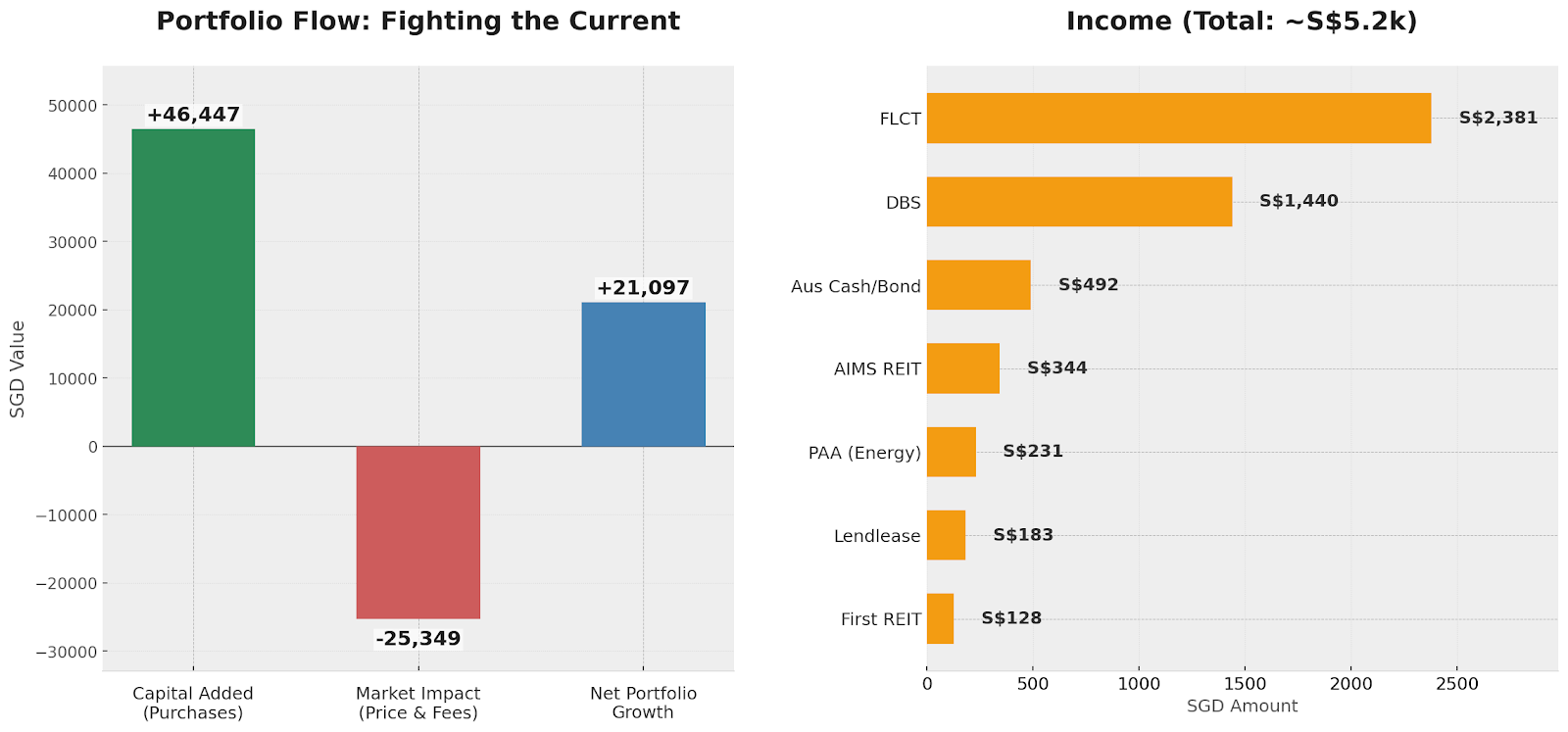
    Market move-S$25,349.2Includes trading fees
    Dividends ReceivedS$5,172.3
    Ending balance (30 Nov)S$2,870,056.1
    Bridge Cash Bucket (BCB)S$150,000 (36% funded)
    Dividend tapS$3,811.25/mth(76.23% of Target)
    Total (Including BCB) S$3,020,056.1

    Note: Dividend tap refers to the portfolio average monthly dividend which is estimated from Snowball Analytics.

    November Portfolio Update

    Purchases (1-30 Nov)

    IWDA (Core): 90 shares @ 126.73 USD, approx S$15,284
    IB01 (Defensive): 110 shares @118.10 USD, approx S$17,000
    SGX:HMN (Country Tilts): 4300 shares @0.940 SGD, S$4,042
    BTC (Alternatives): 0.085003  BTC, approx S$10,479

    Total deployed: approx S$46,447

    November 2025 Portfolio Update– Volatility on the Screen, Progress in the Plan

    November looked dramatic on the charts but quite ordinary for the Atrahasis Portfolio. Stocks sold off, then snapped back. Tech sulked. Bitcoin threw a full‑on tantrum. Underneath all that noise, the portfolio quietly did what it’s built to do: collect income, lean into weakness, and keep risk spread across very different engines.

    The backdrop: a V‑shaped month and a crypto tantrum

    Global equities spent November zig‑zagging. Early in the month, markets were down roughly 4–5% from recent highs before staging a strong rebound into Thanksgiving. The S&P 500 and Dow ended the month with only marginal gains, while the Nasdaq actually finished about 1.5% lower as investors cooled on the frothier end of tech.

    Beneath that, the narrative was all about interest rates. Expectations for a December Federal Reserve rate cut climbed sharply, and longer‑dated yields drifted lower again. That gave Treasuries their fourth straight month of gains and helped stabilise risk assets after the early wobble.

    The real drama, though, came from Bitcoin. After hitting fresh highs earlier in the year, it fell more than 17% in November and briefly traded near a seven‑month low, making this its second‑worst month of 2025. Heavy ETF outflows and short‑term traders bailing out did most of the damage.

    That backdrop matters because Atrahasis now holds a small, deliberate Bitcoin slice alongside its core of global stocks, bonds, REITs and cash.

    Global stocks: still the core engine

    I kept feeding the boring core.

    My main global equity holding remains iShares Core MSCI World (IWDA), which tracks the MSCI World index across 23 developed markets. Over three small trades in November, I added 90 units of IWDA at prices around U$126.

    These buys nudged the portfolio slightly closer to my 40% global equity target without trying to time anything fancy. Markets were wobbly when I added, which is exactly when it feels least comfortable to buy and most important to follow the plan.

    IWDA remains the main “growth engine” of Atrahasis: hundreds of companies, across many countries, all bundled into one very boring, very useful ETF.

    Bonds: the steady ballast

    With sentiment swinging back and forth on interest rates, the safer side of the portfolio quietly did its job.

    Singapore REITs & income: getting paid to wait

    Singapore REITs have been slowly healing as rates stop marching higher and yields settle back into the mid‑5% range. They’re no longer market darlings, but that’s fine by me. At these levels, they’re back to doing what I want them to do: grind out income while I wait.

    I also continued to build up my lodging and hospitality exposure. In November I added more CapitaLand Ascott Trust (HMN), turning it into a meaningful long‑term position in the income sleeve. The exact trade details sit in the transactions section above, but the spirit is simple: keep leaning into solid, diversified REITs when yields are still attractive.

    November itself was a classic “pay month” for Singapore.
    First REIT, Lendlease Global Commercial REIT, AIMS APAC REIT and Frasers Logistics & Commercial Trust all sent in distributions. DBS delivered the star payout with S$1,440 of dividends on its own. Together, the REITs plus DBS added about S$4,500 of fresh cash to the portfolio.

    Overseas, my US energy pipeline holding PAA chipped in as well, paying about US$170 before withholding tax. The Australian income stream continued too, with my AUD cash and bond sleeve generating another chunk of interest.

    All in, November’s income engine provided roughly S$4.5k, A$560 and US$170 in gross distributions across the portfolio. For a month where prices mostly wobbled sideways, that’s a nice reminder of why I like having an income spine running through Atrahasis. Those cashflows can either be redirected into whatever’s cheap, or used to quietly bulk up the safer sleeves without me having to inject new money every time.

    The plan here hasn’t changed: keep REITs and dividend stocks at sensible weights, let them do the heavy lifting on income, and use their payouts to rebalance into weakness rather than chase whatever happens to be hot.

      Bitcoin: leaning into discomfort

      Bitcoin had a rough month, dropping sharply from recent highs as ETF flows cooled and fast money headed for the exit. For most people, that kind of move feels scary. For my tiny allocation, it was simply a live test of whether I’d actually follow my rules.

      Instead of reacting to the noise, I stuck to the script. I made a series of very small buys spread across the month, adding about 0.085 BTC in total — roughly US$7,800 of new capital at the time. No heroics. No “all‑in on the dip.” Just steady dollar‑cost averaging into a pre‑defined, capped risk bucket.

      If Bitcoin keeps sliding, the position will stay small relative to the overall portfolio and I’ll keep accumulating at better prices within that budget. If it recovers, these uncomfortable buys will have done their job. Either way, the key is that this slice is sized so it cannot sink the ship.

      How it all fit together

      On paper, November won’t go down as a spectacular month for the Atrahasis Portfolio. Global stocks were roughly flat, tech was a little soft, bonds were gently positive, and Bitcoin was sharply down. The end result felt more like a sideways walk than a sprint.

      Behaviour‑wise, though, it was an important month:

      • Equities: I kept feeding the global core through IWDA top‑ups, instead of trying to outguess the next headline.

      • Bonds & cash: Short‑dated Treasuries and cash remained the quiet grown‑ups in the room, keeping overall volatility in check while still earning something.

      • REITs & dividends: Singapore REITs, DBS and overseas holdings combined to throw off around S$4.5k, A$560 and US$170 in income, which now sits ready to be redeployed.

      • Bitcoin: The newest, noisiest member of my Alternatives sleeve reminded me why position sizing and rules matter more than bravado or vibes.

      Put differently: when one risky sleeve (Bitcoin) went through a proper drawdown, other parts of the portfolio (short‑dated bonds, cash, income REITs, DBS) quietly absorbed the drama. That’s exactly the trade‑off I signed up for when I chose a diversified, income‑friendly structure instead of a pure‑equity rocket ship.

      Looking ahead to year‑end

      Going into December, the playbook stays boring on purpose:

      • Keep funnelling fresh cash into IWDA as the long‑term growth core.

      • Maintain a solid bond and cash cushion via short‑dated Treasuries and the AUD cash sleeve.

      • Gradually build Singapore REIT and dividend positions while yields remain interesting.

      • Treat Bitcoin as a tiny, volatile satellite governed by rules and sizing, not emotion.

      In a month where headlines shouted about corrections, valuations and crypto drama, the Atrahasis Portfolio mostly just stuck to its script: collect income, rebalance on dips, and let time do the heavy lifting.

      The 3-Bucket Sanity Check: Why My “Broken” Portfolio is Actually Fine

      If you compared the Atrahasis Portfolio to its own allocation rules this month, you would probably tell me to panic.

      My rules-based Asset Allocation Strategy states that 40% of my investable portfolio should be in a Global Core ETF (IWDA). In reality? Inside my main brokerage account, it is sitting at a measly 9.9%.

      My strategy also limits "Country Tilts" (bets on specific regions like Singapore, Australia, or the US) to 10%. In reality? That bucket has swollen to 41.1%.

      By any traditional definition, my portfolio is broken. A robo-advisor would be flashing red warning lights, screaming at me to sell my individual stocks and buy the core.

      But I am not selling. Not yet.

      Why? Because while the micro view is messy, the macro view provides a crucial "Sanity Check" that tells me everything is going according to plan. This is especially true when we view it through the lens of Benjamin Graham, the father of value investing and author of The Intelligent Investor.

      Asset Allocation Strategy

      The Optical Illusion of Failure (The Micro View)

      When we zoom in on the specific "Sleeves" of the Atrahasis portfolio, the drift in the portfolio looks undeniable.

      Current vs target (23 Nov 2025)

      SleeveTarget %Current %Current Δ %
      Global Core (IWDA)409.9–30.1
      Global
      Factor Tilts
      712.29+5.4
      EM ex China65.1–0.9
      Country Tilts1041.1+31.1
      Defensive2215.9–6.1
      Alternatives1210.2–1.8
      AUD FX35.4+2.4

      Graham liked to personify the market as a moody business partner ("Mr. Market") who shows up every day with a quote but never forces you to trade. My sleeve-level “red cells” are just Mr. Market shouting prices at me. The only question that matters is whether my overall policy still makes sense.

      The culprit here is not just "Home Bias." Yes, my Singapore positions (DBS, REITs) are heavy. However, the real "bloat" in my Country Tilt bucket comes from a legacy collection of individual stocks from my active trading days.

      Defensive vs. Enterprising Remnants Looking at this through Graham’s lens, my portfolio is split between a Defensive Core and the leftovers of my old speculative era.

      • The Defensive Engine: IWDA, the factor ETFs, and my REITs. This is the future: minimal fuss, market-like returns.
      • The Enterprising Junkyard: The legacy US single stocks. This is what is left of my stock-picking experiment, now running off in a strictly capped corner of the portfolio.
      Proof I’m Not a Hoarder

      It is easy to say "I will sell eventually." It is harder to actually do it. But looking at my transaction logs, I have already been aggressively cleaning house:

      • Nov 2024: I sold my entire stake of Palantir (PLTR), capturing the massive run-up and exiting the position entirely.
      • May 2021: I sold all my Nvidia (NVDA) shares (pre-splits). While I missed the later AI boom, I stuck to my discipline and took my chips off the table.
      • Dec 2020: I exited Zscaler (ZS) completely, selling into strength to simplify the portfolio.

      I am not blindly holding "forever." I am actively pruning. What remains today is just the "Stubborn Tail": high conviction keepers like Shell and bagholders like Lemonade that I am waiting to break even on.

      The Reality of Risk (The Macro View)

      So, why am I not panic-selling everything today? Because investing is about managing risk in layers.

      When I zoom out to the "3 Buckets" view and include my BCB (Bridge Cash Bucket), which is the liquidity I hold outside the main brokerage, the picture flips.

      Target Allocation (3 Buckets) 23 Nov

      BucketComponentsTarget AllocationCurrent Allocation (w/ BCB)
      EquitiesCore + Factor + EM + Country
      63%63.5%
      Fixed Income, Defensive & Liquidity
      Bonds + AUD FX + BCB25%26.1%
      Alternatives
      Gold + Crypto (BTC, ETH)12%10.4%

      Note: The "Current Allocation" column includes my Bridge Cash Bucket which brings the Fixed Income bucket back to target. Functionally, this BCB is my buffer against the "Sequence of Returns" risk that Bill Bengen highlighted, acting as a bridge so I am never forced to sell equities at a loss during a brutal early-retirement bear market.

      At this level, the portfolio is not broken; it is solid. Graham’s guideline for a defensive investor was simple: keep your stock allocation somewhere between 25% and 75% of your wealth. At roughly 63.5%, I am comfortably inside that sane band.

      The issue is not that I am wildly overexposed to stocks; it is that too much of that equity exposure is sitting in concentrated US names rather than broad, tax-efficient ETFs. This is mainly a Concentration Problem, not a total risk problem.

      The Plan for 2026: The "Situs" Watchlist

      While I am calm about the allocation, I am less calm about the tax risk.

      Many of my legacy positions are US-listed (Micron, Lemonade, Plains All American). For a Singaporean investor with no US estate tax treaty, holding more than $60,000 in US-situs assets brings my estate into the US estate tax regime.

      This is not a hard "cliff" where I lose everything, but it is a threshold where the pain begins. Any value above U$60,000 is taxed at graduated rates starting from 26% and rising to 40%.

      I calculated my exact exposure this morning using the current rate (1 USD ≈ 1.308 SGD), and the numbers are tight.

      Current US Situs Watchlist

      TickerAssetValue (USD)Status
      SHELShell (UK, ADR)~$45,358Keep (Dividend)
      LMNDLemonade~$23,536Sell & Rebalance to Core
      MUMicron~$14,494Keep
      PAAPlains All Am.~$7,643Keep (Dividend)
      CPNGCoupang~$5,590Sell & Rebalance to Core
      OthersPFE, ZROZ, etc.~$6,687Sell & Rebalance to Core
      TotalPure US Assets¬$57,950⚠️ HEADROOM: $2,050

      Note: Shell is a UK-incorporated company held via a NYSE-listed ADR. Current US tax guidance generally treats ADRs of foreign corporations as non-US-situs assets, so Shell likely doesn't count toward the $60k limit. I still include it in my calculations because tax law is complicated.

      My "Pure US" exposure (US-incorporated companies and US-domiciled ETFs) is about U$57,950.

      That leaves roughly $2,050 of headroom. A single good day for Lemonade could push me over the line. While crossing $60k isn't fatal as I would only pay tax on the excess amount, it still creates a tax filing headache and a liability I simply don't want.

      My 2-Step Fix

      1. The "Flow" Fix (For Allocation) The default destination for fresh cash is IWDA and other non-US-situs, Irish-domiciled ETFs. While I still have specific rules to top up Bitcoin or REITs if conditions are right, the heavy lifting of my monthly inflows is now dedicated to the Core. Over time, the Global Core sleeve rises, and the relative weight of the legacy US stock bucket shrinks.

      2. The "Cap" Fix (For Situs Risk) I am treating the US stock sleeve as a "Run-Off" book, but I’m not panic-selling.

      • Growth Trap Exits: If speculative names like LMND ever claw their way back to break-even, I will sell them. That capital will be recycled into Irish-domiciled ETFs (like IWDA) that are generally outside the scope of US estate tax.
      • The Soft Limit (U$60k - U$100k): Since the Estate Tax is graduated (starting at ~26% on amounts over U$60k), crossing the line slightly isn't a disaster. If a rally pushes me into this zone, I will accelerate trimming my "Sell List" stocks like Lemonade and Coupang opportunistically, rather than waiting for a perfect break-even price.
      • The Hard Limit (U$100k): This is the real danger zone. At $100k of US assets, the estate tax liability jumps to over U$10,000 which is a cost I am not willing to bear. If I approach this level, I will be forced to trim even "Keeper" stocks like Micron immediately to get back to safety.

      A Note on "Break-Even": Yes, waiting for "break-even" before selling is technically irrational; the market does not care what my entry price was. I treat this as a behavioral hack: it keeps me emotionally calm while I slowly run off the speculative tail, and I accept that I might leave a bit of expected return on the table in exchange for actually sticking to the plan.

      Conclusion

      If you find yourself staring at a red cell in your spreadsheet and feeling the urge to sell, zoom out.

      My portfolio looks "broken" at the sleeve level, but it remains solid at the bucket level. The easy clean-up work is done. Now, I am executing a disciplined "Run-Off" strategy: diluting the legacy positions with fresh inflows and trimming the weaker US stocks over time, without rushing for the exit just because the margin is tight.

      Disclaimer: None of this is tax or investment advice, just my personal framework as of late 2025. I am not a financial advisor. Please talk to a qualified professional before you copy any of it.