
Disclaimer: I am a blogger, not a doctor. The following article details a personal experiment using Artificial Intelligence to review my health habits. This information is for educational and entertainment purposes only and does not constitute medical advice. Never stop, start, or change the dosage of prescription medications (such as statins) or supplements without consulting a qualified healthcare professional. Interactions can be complex and individual.
Introduction
I sometimes scroll the Chrome Discover feed on my phone, and a few days ago, while scrolling, I caught a reference to a new study published in late 2025 in Cell: “Comprehensive human proteome profiles across a 50-year lifespan reveal aging trajectories and signatures.”
I managed to get my hands on the full text of the paper and the findings were fascinating. Researchers had mapped how the human proteome (the entire set of proteins expressed by our genome) shifts over five decades. The takeaway wasn't just that we age; it’s that aging is biological, measurable, and systematic.
Even more striking were the inflection points: specific milestones: clustered around ages 45 and 60, where the body undergoes rapid molecular shifts, rather than just a slow, steady slide. Seeing the number 45 resonated deeply, as it is uncomfortably close to my own age.
I put down my phone and looked at the side of my workdesk where I keep my supplements. Sitting there was my chaotic "supplement graveyard", a cluster of bottles I’ve accumulated over the last few years. A multivitamin here, a heart-health pill there, something a podcast recommended in 2022.
The contrast was jarring. Science is measuring aging with molecular precision, and I’m combating it by randomly popping pills whenever I remember to, usually right before brushing my teeth.
I realized I needed a second opinion. Not just a Google search, but an audit. Since the new Gemini 3 Pro had just launched with rave reviews for its reasoning capabilities, I decided to hire it as my temporary, unpaid biological consultant to perform a limited AI health audit.
I wanted to know: Is my routine actually supporting my longevity, or am I just making expensive urine? And, true to the spirit of Atra-Hasis, how does extending my "healthspan" change the math of my financial independence?
Here is what happened when I let an AI take apart my daily supplement routine.
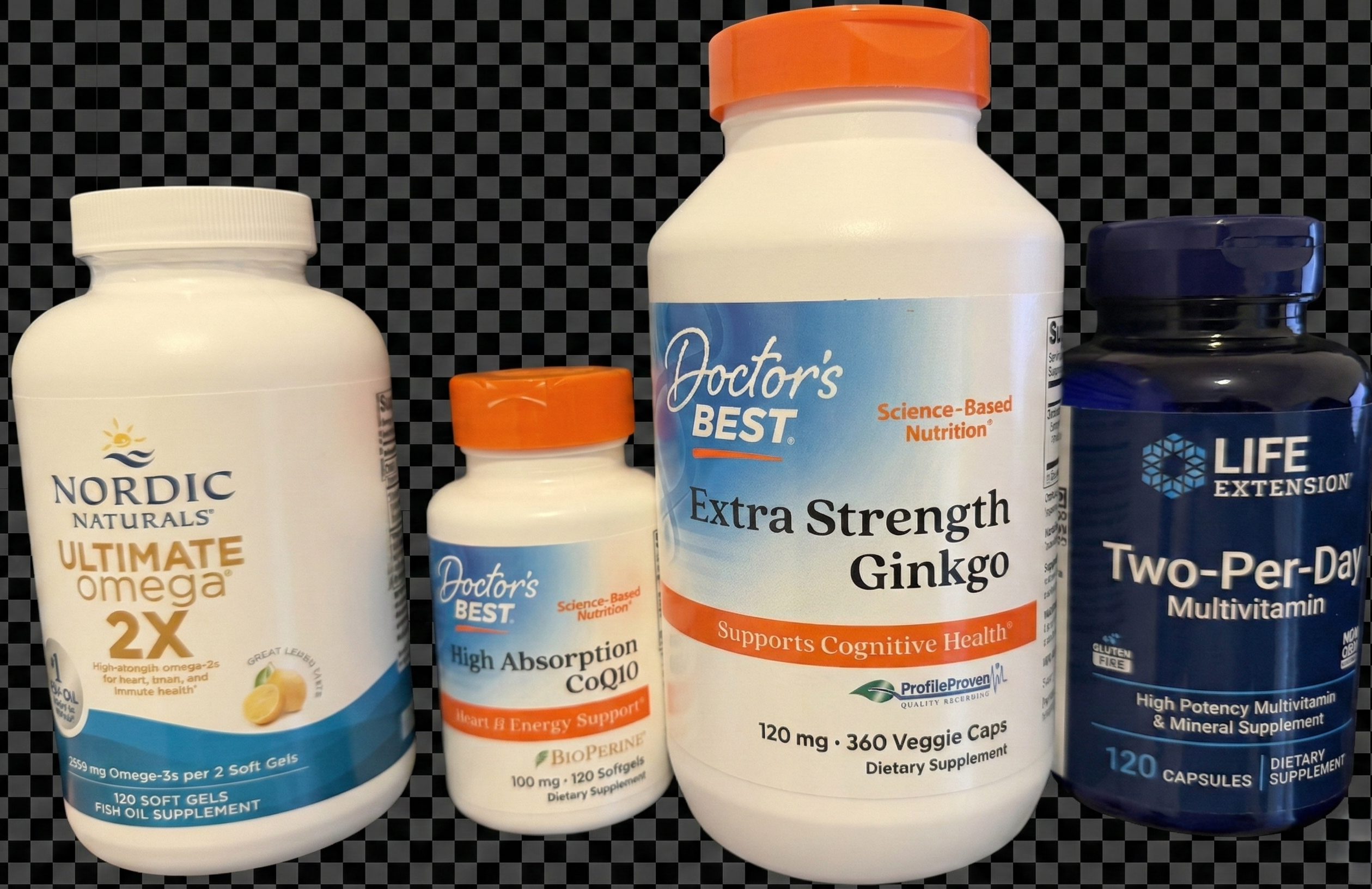
Some of the supplements i take daily
From Proteome Papers to Pill Bottles
I uploaded the full PDF of the Cell paper to Gemini. I started our session by asking it to synthesize the findings and apply them to my context.
"Based on what we know about proteomic aging trajectories from the paper," I asked, "what are the low-hanging fruits for me to incorporate into my supplement strategy?"
Gemini’s synthesis was sharper than I expected. It focused heavily on maintenance and highlighted a key concept from the paper: the "Senohub."
The study identified the Aorta (the main artery) as a tissue that ages earliest and acts as a "Senohub," spreading inflammatory signals to other organs. This made the AI's lifestyle recommendations hit harder:
- Zone 2 Cardio: Not just for "fitness," but specifically to maintain vascular elasticity and delay the aorta's transition into a senescence generator.
- Blood Pressure Control: The silent killer of longevity.
- Heat Shock Proteins: Via sauna use, to aid protein folding (highly relevant to a paper on the proteome).
- Nutrient Timing: Not just what you eat, but when.
I was already doing the cardio (and counting my scalding hot showers as "heat exposure"). But the "timing" point stuck out. That’s when I decided to bare my soul (and my medicine cabinet) to the machine.
The Sleep Sabotage
The first thing Gemini flagged was the timing of the multivitamin and my Ginkgo supplement.
"You are taking a high-potency B-Complex (included in your multivitamin) and a cerebral stimulant (Ginkgo) right before attempting to enter deep sleep," it noted. "B-vitamins are co-factors in energy production, and Ginkgo Biloba can increase alertness and cerebral blood flow. While they don't have caffeine, they are biologically stimulating and could be interfering with your sleep architecture."
I paused. I had been struggling with waking up groggy recently, despite getting "enough" hours. I had assumed it was stress or too much screentime. I never considered that my "health" habit was keeping my brain buzzing at 11:00 PM.
Gemini advised shifting both the multivitamin and the Ginkgo to breakfast or lunch immediately.
The Statin, CoQ10, and BioPerine Triangle
Then we got into the more delicate territory: my prescription statin and how it fits with my supplements. This was where the AI impressed me by spotting issues a human might miss.
I take Rosuvastatin daily. It is well-documented that statins can deplete the body's natural levels of CoQ10, which is why I supplement it.
Here’s the issue: the CoQ10 product I take also contains BioPerine (piperine), a black pepper extract that’s marketed as an “absorption enhancer.”
Gemini pointed out that piperine has been shown in some studies to affect how the body handles certain drugs and nutrients, by influencing enzymes and transporters involved in metabolism and absorption. The human evidence at typical supplement doses is limited and often theoretical, but it was enough to raise a simple question:
If I don’t need to take my statin at the exact same moment as an absorption enhancer, why create extra uncertainty?
Rosuvastatin is less dependent on some of the classic pathways people worry about (for example, it relies less on CYP3A4 than statins like simvastatin), and I didn’t find strong evidence that my specific combo is dangerous. Still, the overall message I took away was: when you’re combining prescription meds with “bioavailability boosters,” it’s reasonable to be cautious and to loop in a doctor or pharmacist.
So here’s the personal experiment I landed on, not a general recommendation:
- CoQ10 (with food) in the morning or lunch. (CoQ10 is fat-soluble and gives energy, which was another reason not to take it at night).
- Rosuvastatin in the evening.
Gemini also nudged me to look into Ubiquinol (the reduced form of CoQ10), which may be better absorbed as people age. That’s something I’ll discuss with my doctor before switching, rather than just swapping capsules on my own.
None of this is medical advice. It’s simply how I used AI to surface a potential interaction, then chose a conservative timing change while I seek a professional opinion.
Redesigning the Stack and the Process
I didn't just take the Gemini's word for it. I spent the next evening cross-referencing its claims against reputable medical sites and also its cousin ChatGPT 5.1 Pro.
The verdict? It was mostly right. B-vitamins and Ginkgo could disrupt sleep. CoQ10 is better taken with fat in the morning. And spacing out absorption enhancers from prescription meds is just good hygiene.
I rebuilt my protocol from first principles:
- Morning (breakfast): Life Extension Multivitamin + CoQ10 + Omega-3s + Ginkgo biloba. (Fuel for the day, and keeping things simple).
- Pre-Bed: Magnesium Glycinate (supports relaxation) + Rosuvastatin.
The Early Results
I’ve been on this AI-audited routine for a few days now, and the difference isn't a placebo.
My Apple Watch (using the AutoSleep app) tracks my sleep, and for the last three nights, I have exceeded 3 hours of Deep Sleep. Before this, I struggled to get past 1.5 hours.
Of course, I need more data to confirm the trend, but the contrast is there. I’m no longer waking up feeling like I spent the night solving algebra equations, and my routine finally feels intentional.
How to Use AI for Your Own Health (Without Being Reckless)
If you want to perform this limited AI health audit yourself, do not treat Gemini or ChatGPT as a doctor. Treat them as a research assistant who has read every abstract but has zero clinical experience.
What to Provide the AI
To get good results, you need to be radically specific:
- The Full List: Every supplement, brand, and dosage. A picture of the back of the supplement bottle, showing its ingredients, is also good.
- Prescriptions: List everything and dosages.
- Timing: When do you take them?
- Goals: "I want to improve energy," or "I want to lower inflammation."
- Biomarkers: If you have recent blood work (cholesterol, Vitamin D levels), reference it.
Good Ways to Use AI
- "Check for Interactions": Ask it to cross-reference your list for drug-nutrient or nutrient-nutrient interactions.
- "Audit for Timing": Ask what time of day is optimal for absorption and sleep.
- "Identify Redundancies": Ask if you are double-dosing on anything (e.g., getting Zinc from both a multi and a ZMA supplement).
The Pitfalls
- Hallucinations: AI can invent studies. Always ask for sources or verify claims via Google/PubMed.
- Nuance Blindness: AI tends to be generic. It doesn't know your liver function or genetic history unless you tell it.
-
The "More is Better" Trap: AI might suggest adding things. Be skeptical. Subtraction is often the best medicine.
Longevity, Healthspan, and Financial Planning
Why am I writing about CoQ10 interactions on a finance blog?
Because Atra-Hasis is about the systems that sustain us. We spend thousands of hours optimizing our asset allocation, tweaking our Safe Withdrawal Rates (SWR), and minimizing tax drag.
But biological aging is the ultimate "inflation." It erodes your most valuable asset: your ability to enjoy the wealth you're building.
If I successfully extend my healthspan, e.g. if I am hiking at 80 instead of sitting in a chair, that changes my financial plan fundamentally:
- The Time Horizon: My portfolio might need to last for 40 years of retirement or more, not 30. That might require lowering my SWR from 3.25%.
- Healthcare Costs: The most expensive years are the final ones. A healthier 80-year-old might spend less on chronic care but needs a larger buffer for a longer, fuller life.
- Human Capital: Improved health means I have the option to work longer on projects I love, reducing sequence-of-returns risk.
Using AI to audit my health is exactly like using a Monte Carlo simulation to audit my portfolio. It’s about finding the weak points, checking the correlations (interactions), and optimizing for durability.
Conclusion
Gemini 3 Pro didn't save my life, but it arguably improved my nights. It acted as a mirror, showing me that my "health routine" had become a mindless habit rather than a strategic protocol.
We are entering an era where we can have a hyper-intelligent co-pilot for our biology. It’s on us to use it wisely, to ask the right questions, fact-check the answers, and realize that staying healthy is the longest-term investment we’ll ever make.
Audit your stack. Check your timing. And sleep well.