The 3-Bucket Sanity Check: Why My “Broken” Portfolio is Actually Fine

If you compared the Atrahasis Portfolio to its own allocation rules this month, you would probably tell me to panic.

My rules-based Asset Allocation Strategy states that 40% of my investable portfolio should be in a Global Core ETF (IWDA). In reality? Inside my main brokerage account, it is sitting at a measly 9.9%.

My strategy also limits "Country Tilts" (bets on specific regions like Singapore, Australia, or the US) to 10%. In reality? That bucket has swollen to 41.1%.

By any traditional definition, my portfolio is broken. A robo-advisor would be flashing red warning lights, screaming at me to sell my individual stocks and buy the core.

But I am not selling. Not yet.

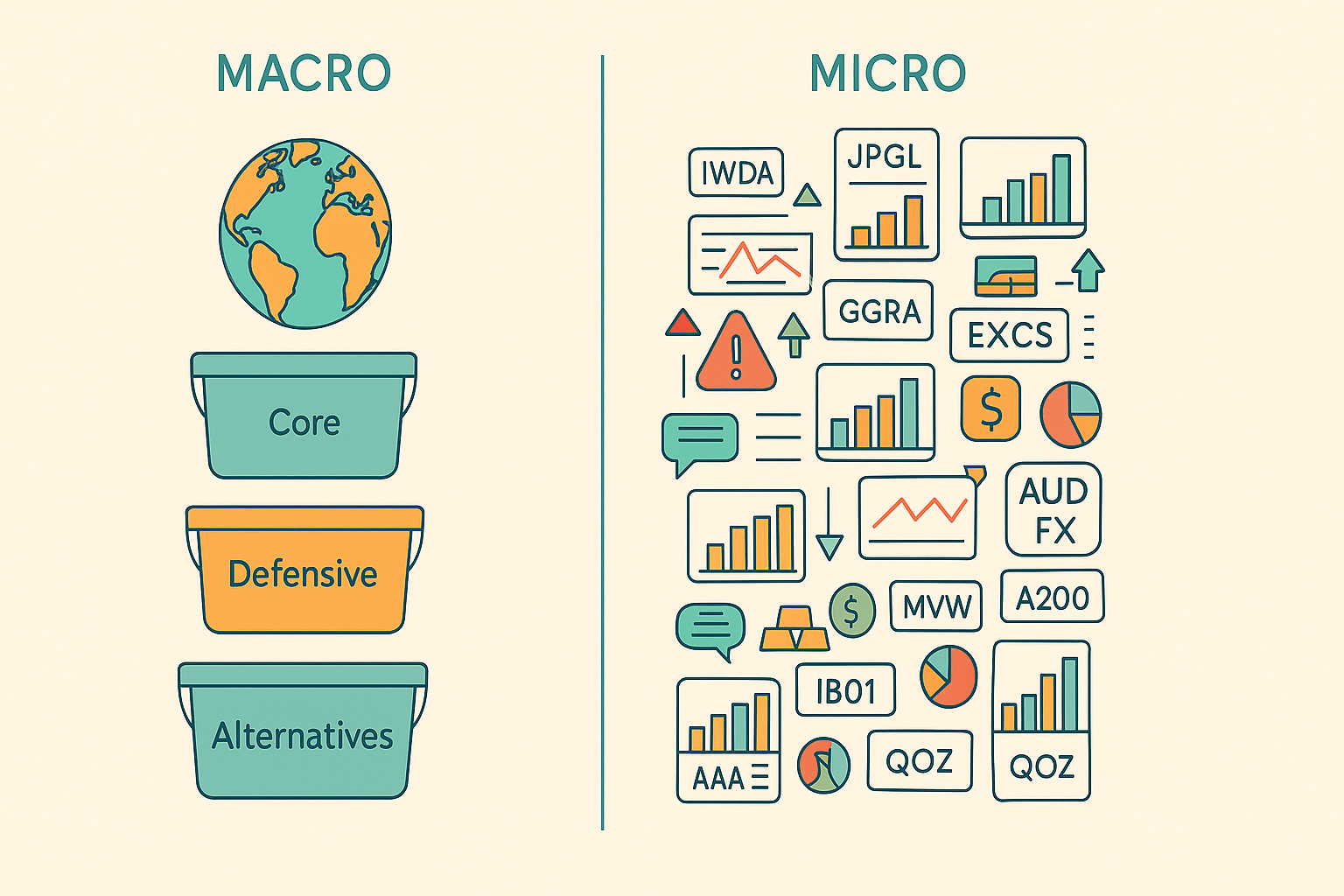
Why? Because while the micro view is messy, the macro view provides a crucial "Sanity Check" that tells me everything is going according to plan. This is especially true when we view it through the lens of Benjamin Graham, the father of value investing and author of The Intelligent Investor.

Asset Allocation Strategy

The Optical Illusion of Failure (The Micro View)

When we zoom in on the specific "Sleeves" of the Atrahasis portfolio, the drift in the portfolio looks undeniable.

Current vs target (23 Nov 2025)

SleeveTarget %Current %Current Δ %
Global Core (IWDA)409.9–30.1
Global
Factor Tilts
712.29+5.4
EM ex China65.1–0.9
Country Tilts1041.1+31.1
Defensive2215.9–6.1
Alternatives1210.2–1.8
AUD FX35.4+2.4

Graham liked to personify the market as a moody business partner ("Mr. Market") who shows up every day with a quote but never forces you to trade. My sleeve-level “red cells” are just Mr. Market shouting prices at me. The only question that matters is whether my overall policy still makes sense.

The culprit here is not just "Home Bias." Yes, my Singapore positions (DBS, REITs) are heavy. However, the real "bloat" in my Country Tilt bucket comes from a legacy collection of individual stocks from my active trading days.

Defensive vs. Enterprising Remnants Looking at this through Graham’s lens, my portfolio is split between a Defensive Core and the leftovers of my old speculative era.

  • The Defensive Engine: IWDA, the factor ETFs, and my REITs. This is the future: minimal fuss, market-like returns.
  • The Enterprising Junkyard: The legacy US single stocks. This is what is left of my stock-picking experiment, now running off in a strictly capped corner of the portfolio.
Proof I’m Not a Hoarder

It is easy to say "I will sell eventually." It is harder to actually do it. But looking at my transaction logs, I have already been aggressively cleaning house:

  • Nov 2024: I sold my entire stake of Palantir (PLTR), capturing the massive run-up and exiting the position entirely.
  • May 2021: I sold all my Nvidia (NVDA) shares (pre-splits). While I missed the later AI boom, I stuck to my discipline and took my chips off the table.
  • Dec 2020: I exited Zscaler (ZS) completely, selling into strength to simplify the portfolio.

I am not blindly holding "forever." I am actively pruning. What remains today is just the "Stubborn Tail": high conviction keepers like Shell and bagholders like Lemonade that I am waiting to break even on.

The Reality of Risk (The Macro View)

So, why am I not panic-selling everything today? Because investing is about managing risk in layers.

When I zoom out to the "3 Buckets" view and include my BCB (Bridge Cash Bucket), which is the liquidity I hold outside the main brokerage, the picture flips.

Target Allocation (3 Buckets) 23 Nov

BucketComponentsTarget AllocationCurrent Allocation (w/ BCB)
EquitiesCore + Factor + EM + Country
63%63.5%
Fixed Income, Defensive & Liquidity
Bonds + AUD FX + BCB25%26.1%
Alternatives
Gold + Crypto (BTC, ETH)12%10.4%

Note: The "Current Allocation" column includes my Bridge Cash Bucket which brings the Fixed Income bucket back to target. Functionally, this BCB is my buffer against the "Sequence of Returns" risk that Bill Bengen highlighted, acting as a bridge so I am never forced to sell equities at a loss during a brutal early-retirement bear market.

At this level, the portfolio is not broken; it is solid. Graham’s guideline for a defensive investor was simple: keep your stock allocation somewhere between 25% and 75% of your wealth. At roughly 63.5%, I am comfortably inside that sane band.

The issue is not that I am wildly overexposed to stocks; it is that too much of that equity exposure is sitting in concentrated US names rather than broad, tax-efficient ETFs. This is mainly a Concentration Problem, not a total risk problem.

The Plan for 2026: The "Situs" Watchlist

While I am calm about the allocation, I am less calm about the tax risk.

Many of my legacy positions are US-listed (Micron, Lemonade, Plains All American). For a Singaporean investor with no US estate tax treaty, holding more than $60,000 in US-situs assets brings my estate into the US estate tax regime.

This is not a hard "cliff" where I lose everything, but it is a threshold where the pain begins. Any value above U$60,000 is taxed at graduated rates starting from 26% and rising to 40%.

I calculated my exact exposure this morning using the current rate (1 USD ≈ 1.308 SGD), and the numbers are tight.

Current US Situs Watchlist

TickerAssetValue (USD)Status
SHELShell (UK, ADR)~$45,358Keep (Dividend)
LMNDLemonade~$23,536Sell & Rebalance to Core
MUMicron~$14,494Keep
PAAPlains All Am.~$7,643Keep (Dividend)
CPNGCoupang~$5,590Sell & Rebalance to Core
OthersPFE, ZROZ, etc.~$6,687Sell & Rebalance to Core
TotalPure US Assets¬$57,950⚠️ HEADROOM: $2,050

Note: Shell is a UK-incorporated company held via a NYSE-listed ADR. Current US tax guidance generally treats ADRs of foreign corporations as non-US-situs assets, so Shell likely doesn't count toward the $60k limit. I still include it in my calculations because tax law is complicated.

My "Pure US" exposure (US-incorporated companies and US-domiciled ETFs) is about U$57,950.

That leaves roughly $2,050 of headroom. A single good day for Lemonade could push me over the line. While crossing $60k isn't fatal as I would only pay tax on the excess amount, it still creates a tax filing headache and a liability I simply don't want.

My 2-Step Fix

1. The "Flow" Fix (For Allocation) The default destination for fresh cash is IWDA and other non-US-situs, Irish-domiciled ETFs. While I still have specific rules to top up Bitcoin or REITs if conditions are right, the heavy lifting of my monthly inflows is now dedicated to the Core. Over time, the Global Core sleeve rises, and the relative weight of the legacy US stock bucket shrinks.

2. The "Cap" Fix (For Situs Risk) I am treating the US stock sleeve as a "Run-Off" book, but I’m not panic-selling.

  • Growth Trap Exits: If speculative names like LMND ever claw their way back to break-even, I will sell them. That capital will be recycled into Irish-domiciled ETFs (like IWDA) that are generally outside the scope of US estate tax.
  • The Soft Limit (U$60k - U$100k): Since the Estate Tax is graduated (starting at ~26% on amounts over U$60k), crossing the line slightly isn't a disaster. If a rally pushes me into this zone, I will accelerate trimming my "Sell List" stocks like Lemonade and Coupang opportunistically, rather than waiting for a perfect break-even price.
  • The Hard Limit (U$100k): This is the real danger zone. At $100k of US assets, the estate tax liability jumps to over U$10,000 which is a cost I am not willing to bear. If I approach this level, I will be forced to trim even "Keeper" stocks like Micron immediately to get back to safety.

A Note on "Break-Even": Yes, waiting for "break-even" before selling is technically irrational; the market does not care what my entry price was. I treat this as a behavioral hack: it keeps me emotionally calm while I slowly run off the speculative tail, and I accept that I might leave a bit of expected return on the table in exchange for actually sticking to the plan.

Conclusion

If you find yourself staring at a red cell in your spreadsheet and feeling the urge to sell, zoom out.

My portfolio looks "broken" at the sleeve level, but it remains solid at the bucket level. The easy clean-up work is done. Now, I am executing a disciplined "Run-Off" strategy: diluting the legacy positions with fresh inflows and trimming the weaker US stocks over time, without rushing for the exit just because the margin is tight.

Disclaimer: None of this is tax or investment advice, just my personal framework as of late 2025. I am not a financial advisor. Please talk to a qualified professional before you copy any of it.

Confessions of a Conservative Investor: Why I Own Bitcoin

The recent price action in Bitcoin has been... turbulent. We saw a sharp pullback recently, and headlines have been busy declaring the end of the run. Meanwhile, true to the rules of the Atrahasis Portfolio, I have been quietly nibbling. No panic, just process. When the allocation drops below my target bands, I buy.

But this calm, rules-based approach wasn't always my default setting. My history with Bitcoin didn't start with disciplined accumulation. It started with a search for aliens, a miscalculation, and a brief, adrenaline-fueled stint as an amateur "trader".

The 100x Return That Should Have Been 10,000x

In 2012, I was using my PC to search for extraterrestrial life. I didn't find any aliens, but I did stumble onto something that would eventually become 5% of my net worth.

I had just bought a spanking new PC. It was a beast of a machine for the time. I could not bear the thought of it sitting idle while I was at work or sleeping. I was obsessed with squeezing every ounce of utility out of that hardware.

I cycled through all the distributed computing projects I could find. I ran Folding@home to help simulate protein dynamics for disease research. I ran SETI@home to analyze radio signals in the search for extraterrestrial life. I even joined the Great Internet Mersenne Prime Search (GIMPS). I remember thinking that if my GPU got lucky and found a new prime number, there was a cash reward attached to it. It felt like buying a lottery ticket where the price of entry was just electricity.

Then I stumbled upon a novelty called Bitcoin, which had just been invented a few years earlier in 2009.

I downloaded a miner and let the GPU hum away for a few months. It generated heat and noise in the corner of my room. After about 3 months, I sat down and did the math. The electricity bill from Singapore Power had spiked. The value of the coins I had mined was underwhelming. In fact, I had paid more in power bills than the Bitcoin was worth back then.

Feeling foolish, I shut it down. When I eventually upgraded my PC again, I yanked the old hard drive, tossed it in a drawer, and forgot about it.

Fast forward to 2016. Bitcoin spiked.

I scrambled. I tore through my drawers to find that dusty HDD. I prayed the platters still spun. They did. I located the wallet.dat file and stared at the balance. In absolute terms, it was not life-changing money. But in percentage terms, it was a 100x return.

I felt like a genius. I sold every single satoshi immediately on FYB-SG, one of the earliest exchanges in Singapore. I told myself that this was a bubble. I told myself to take the win because it could not possibly go higher.

We all know what happened next.

The Second Roll of the Dice: BitMEX and Ethereum

You would think missing out on the 2017 mega-rally would have scared me off. Instead, it pulled me back in.

Between 2017 and 2018, I decided to press my luck again. This time, I wasn't mining; I was trading. I discovered BitMEX and the high-octane world of crypto futures. It was a wild, volatile period. I was shorting Bitcoin futures, watching the charts swing violently up and down. It was pure adrenaline, far removed from the "boring" investing I advocate for today.

Somehow, through a mix of volatility and sheer luck, I came out ahead. I walked away with a profit of 3 BTC.

That was my "enough" moment. I realized I had lucked out, and I wasn't going to push it until the house won it back. I sold some of that profit for cash to lock in the win. The rest? I converted it into Ethereum (ETH).

I still hold that ETH today. It sits in my portfolio not as a testament to my trading skills, but as a reminder of the time I got lucky and knew when to stop.

The Barbell Effect: Fire and Ice

Today, I do not trade futures. I do not mine for pennies. I simply allocate.

Most traditional portfolios are a "mushy middle" mixture of stocks and bonds that tend to move somewhat together. My strategy is different. It is built on two extremes that hate each other. I call this the Fire and Ice approach.

The Ice: The Foundation (25%)
  • Assets: ERNA (IG Bonds), Govt Bonds (IB01), AUD FX.
  • The Job: Survival.

This is the boring stuff. It yields 2% to 4% and barely beats inflation. But its job is not to make me rich. Its job is to stop me from being poor. When the stock market crashes 20%, my "Ice" sleeve barely moves. It sits there. It is cold and reliable. It ensures that I never have to sell a single share of stock to pay for groceries. It is the potion that lets me sleep at night.

The Fire: The Hedge (12%)
  • Assets: Bitcoin, Gold, ETH.
  • The Job: Insurance against the system.

This is where people get confused. They ask why a conservative investor like me holds Bitcoin.

I hold it because I am conservative.

In 2012, I mined Bitcoin as a novelty. In 2017, I gambled on it as a trader. Today, I hold it as insurance. If the "Ice" melts because of hyperinflation or endless money printing, the "Fire" tends to rage.

I do not know if Bitcoin will go to S$1 million or S$10,000. And I do not care.

If it goes to zero, I lose a capped portion of my portfolio. My "Ice" ensures I am still fine. If it does another 10x, it moves the needle significantly for my net worth.

This is asymmetric upside. Unlike my 2016 self, I am not trying to time the sale. I am simply holding a fixed allocation.

The Rules of Engagement

The problem with "Fire" is that it burns. Crypto is volatile. To keep it in my "calm" portfolio, I wrap it in strict rules.

  1. The Cap: My "Alternatives" sleeve is capped at roughly 12%. It is enough to matter but not enough to ruin me.
  2. The Rebalance: When Bitcoin crashes, I do not panic. I use fresh funds from my income to buy more. This brings the allocation back up. When it moons? I sit on my hands. I learned in 2016 that selling a winner is often a mistake. I prefer to rebalance by adding to my boring assets, not by cutting my high-performers.
  3. No Predictions: I do not read charts. I do not listen to crypto influencers. I just look at my spreadsheet. Is the percentage low? Buy. Is it high? Wait.

Why We Build the Ark

In the story of Atrahasis, the protagonist did not stop the flood. He built a boat to ride it out.

My 2016 sale was a mistake because I thought I could predict the weather. I thought the storm was over. My current portfolio assumes the storm never ends. It just changes form. Sometimes it rains deflation and the Ice wins. Sometimes it rains inflation and the Fire wins.

I have about S$3 million in this Ark now. A 2% swing is now a year’s worth of median Singaporean salary. I cannot afford to gamble like I did with that dusty hard drive or that BitMEX account. But I also cannot afford to ignore the assets that defined the last decade.

So I hold both. I hold the Fire, and I hold the Ice. And somewhere in the middle, I sleep soundly.

bitcoin fire and ice

Building My Financial Independence Plan from First Principles

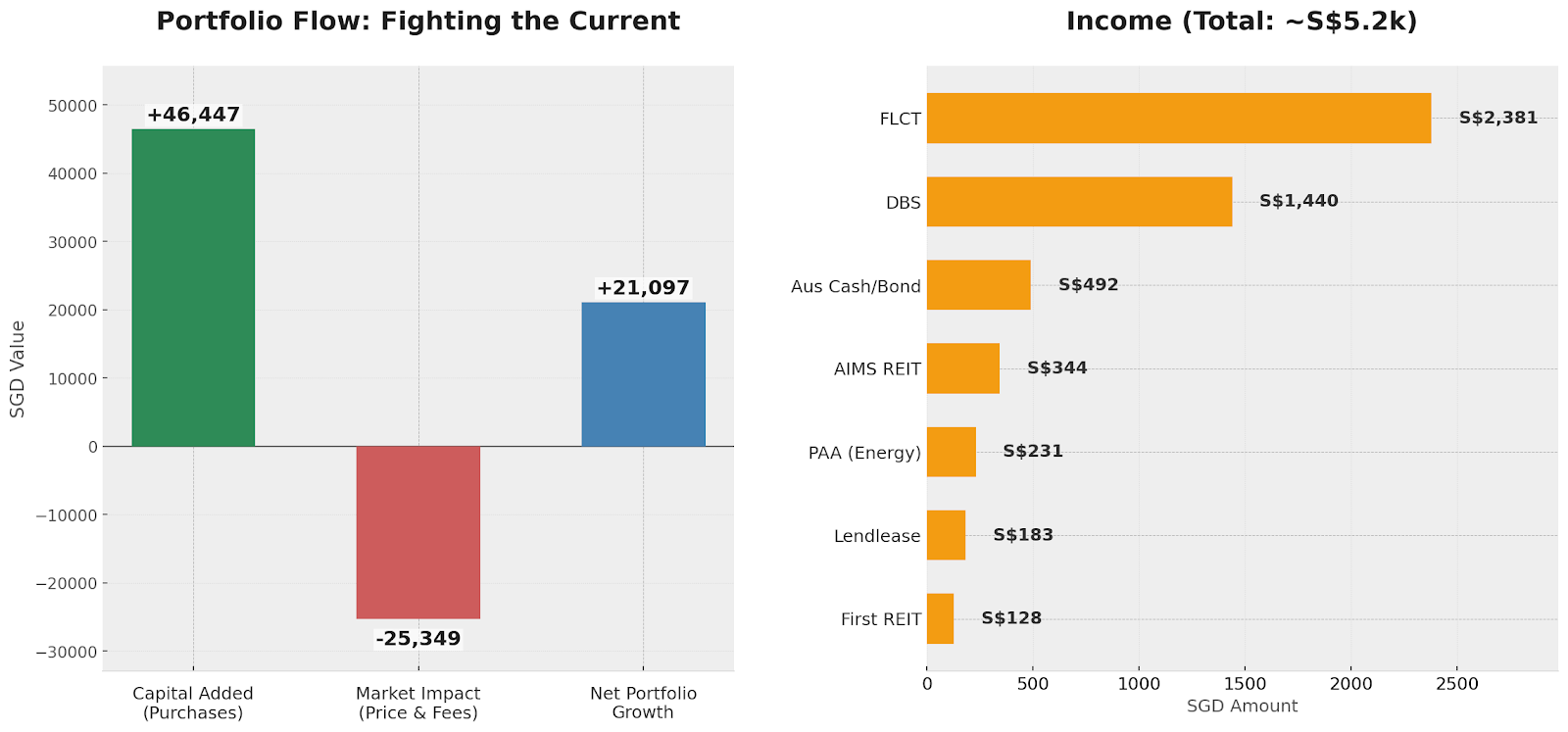
Atrahasis Portfolio Key Numbers (MTD Nov  2025)

MTD return (excluding contributions)-0.86%
Starting balance (1 Nov) S$2,848,958.7
Purchases S$30,333.5
Market move-S$25,224.8
Dividends ReceivedS$472.5
Ending balance (14 Nov)S$2,854,539.9
Bridge Cash Bucket (BCB)S$150,000 (36% funded)
Dividend tapS$3,811.25/mth(76.23% of Target)
Total (Including BCB) S$3,004,539.9

Note: Dividend tap refers to the portfolio average monthly dividend which is estimated from Snowball Analytics.
Purchases (1-14 Nov)

IWDA (Core): 50 shares @127.38 USD, approx S$8,285
IB01 (Defensive): 110 shares @118.10 USD, approx S$16,897
BTC (Alternatives): 0.03820534  BTC, approx S$4,990

Total deployed: S$30,333.5

My Financial Independence Framework

Assumptions I use for planning

Before anything else, I define my working assumptions.
They are not fixed for life. They simply give me a clear frame to build around.

1. Monthly lifestyle anchors

  • Basic FI at S$12,000

  • Full FI at S$20,000

2. Spending context

  • Singapore’s latest average household expenditure (2023, SingStat) is S$5,931

  • Basic FI is roughly twice that

  • Full FI is about three and a half times that

3. Income taps

  • A future dividend stream of about S$5,000 a month in today's dollars.

  • CPF LIFE starting around age 70 under the Enhanced Retirement Sum

4. Portfolio structure

Since I want to stop full time work around 48, I will need to fund my lifestyle until CPF LIFE begins. I call this period the bridge. To handle the bridge safely without giving up long term returns, I use a simple design:

  • A 5 year safe bucket in SGD (HYSAs, SSBs etc) (Bridge Safe Bucket)

  • The rest of the bridge invested in the usual global mix

  • A long term draw rate of about 3.25 percent

  • A 10 percent USD cushion applied to the long term drawdown pot, since much of my portfolio is in USD but my spending is in SGD

5. Retirement timing

  • Stop full time work around 48

  • Build a bridge to CPF LIFE

These assumptions keep the plan grounded in reality rather than guesswork.

Anchors, Not Absolutes

I anchor my FI thinking to two monthly numbers. Basic FI at twelve thousand a month and Full FI at twenty thousand a month. They are guides rather than rigid targets.

Basic FI is the level where life works smoothly. Bills, school fees, groceries, transport and healthcare are all covered. Work becomes optional rather than compulsory.

Full FI is the level where life opens up. A nicer home is possible. Better holidays fit comfortably. A car is within reach if I want one. The quality of life feels wider with less hesitation at each decision point.

Once I know the lifestyle I want to fund, the portfolio becomes a tool rather than the purpose. Everything I build supports one of these two anchors.

Two Phases Instead of One Giant Target

My FI plan has two very different stretches.

Phase 1: Age 48 to 70

The early retirement years before CPF LIFE begins.
My spending will come from dividends and a controlled draw from the portfolio.

Phase 2: Age 70 onward

CPF LIFE begins and becomes a strong SGD income floor.
Dividends continue.
The portfolio only tops up the remaining gap.

The Dividend Tap

My Singapore holdings already generate steady income. Over time I want this stream to settle around S$5,000 a month in today’s dollars. This is not a separate FI target. It is simply one of the taps that funds the same two FI anchors.

I treat this dividend stream as spendable income. I do not also include the capital that produces it inside the 3.25 percent drawdown pool. That keeps the income and the drawdown maths separate and avoids double counting. Therefore I need to set aside S$1,000,000, assuming 6% yield.

If this tap contributes five thousand a month, then the portfolio only needs to supply:

  • Basic FI gap: S$7,000 a month

  • Full FI gap: S$15,000 a month

This reduces the burden on the drawdown portfolio, especially in the earlier years.

A Bridge That Does Not Kill Returns

Retiring at 48 creates a long bridge before CPF LIFE starts.
But I do not try to park 22 years of spending in cash. That would destroy returns.

I use a simple two-layer bridge instead.

1. A safe bucket for 5 years (Bridge Cash Bucket)

This sits in SGD cash, T bills, SSBs and short duration bond funds.
This protects the first years of early retirement and prevents panic selling in a downturn.

2. The remaining bridge stays fully invested

This part behaves like the rest of the Atrahasis portfolio.
It grows ahead of inflation and refills the safe bucket when markets allow.

Each year I spend from the safe bucket.
If markets are calm, I trim invested assets to refill it.
If markets are rough, I stretch the safe bucket and delay refills.

The bridge stays shallow but resilient. It is not frozen for 22 years.

CPF LIFE at 70 for a Stronger Floor Later

If I set aside the Enhanced Retirement Sum at 55 and start CPF LIFE at 70, payouts should land around 4,000 to 4,300 SGD a month in today’s dollars.

From age 70 onward my stable SGD income becomes:

  • CPF LIFE payouts

  • Monthly dividends

Together that is roughly S$9,200 a month.

The portfolio only needs to top up:

  • Basic FI: about S$2,800 a month

  • Full FI: about S$10,800 a month

At a long term draw rate of about 3.25 percent, this works out to:

  • Basic FI: about 1.03 million SGD (33,600 ÷ 0.0325)

  • Full FI: about 3.99 million SGD (129,600 ÷ 0.0325)

Sizing the Long Term Pot with a Currency Cushion

Because a large part of my portfolio is in USD, I size the long term drawdown pot assuming a 10 percent USD drop at the wrong moment.

After applying this cushion and keeping a small SGD buffer, the long term pot I aim for is roughly:

  • Basic FI: about 1.2 million SGD

  • Full FI: about 4.3 million SGD

These are working ranges rather than rigid targets. They help me stay honest about currency and market risk.

Putting the Structure Together with Two Buckets

I think about the portfolio as two buckets. The dividend bucket D is the capital that supports the S$5,000 a month in SGD dividends. The drawdown bucket R is the rest of the Atrahasis portfolio that I am willing to sell down slowly.

I now assume that about S$1,000,000 sits in D. At a net yield of roughly 6 percent, that pays about S$60,000 a year, or S$5,000 a month, which is the dividend tap I am targeting. This capital is not counted inside the 3.25 percent drawdown pool R.

The drawdown bucket R then needs to cover the remaining gaps, both in the bridge years and after CPF LIFE starts. On my current assumptions, R needs roughly S$2.6 to S$2.8 million for Basic FI and S$7.4 to S$7.6 million for Full FI.

That means the total portfolio requirement, D plus R, is about S$3.6 to S$3.8 million for Basic FI and about S$8.4 to S$8.6 million for Full FI.

Basic FI path

Total portfolio needs of roughly 3.6 to 3.8 million SGD

Full FI path

Total portfolio needs of roughly 8.4 to 8.6 million SGD

These ranges shift slightly with markets and life choices, but the structure stays stable.

Where I Stand Today

With the current portfolio at about S$3.0 million including the Bridge Cash Bucket, I am roughly 80 percent of the way to the Basic FI total of 3.6 to 3.8 million and about 35 percent of the way to the Full FI total of 8.4 to 8.6 million. The dividend tap is about 76 percent built and the first layer of the Bridge Cash Bucket is forming. The structure is clear. From here the work is to finish the dividend bucket, complete the five year safe bucket, and let the global engine do its compounding in the background.

October 2025 Portfolio Update: A Calm Climb Amid Subtle Shifts

Key Numbers (Oct  2025)

  • 1‑month return (excluding contributions): +2.29%

  • Year‑to‑date (YTD) return: +10.66%

  • Starting balance (1 Oct): S$2,707,643.64

  • Purchases : S$78,073.16

  • Market move: +S$62,088.7

  • Dividends Received: +S$1,699.81
  • Ending balance (31 Oct): S$2,847,805.47

Purchases (1-31 Oct)

IWDA (Core): 270 shares, approx S$44,658
IB01 (Defensive): 100 shares, approx S$15,345
ERNA (Defensive): 1000 shares, approx S$8,086
Keppel DC REIT (Country Tilt): 1448 shares, approx S$3,242
BTC (Alternatives):
0.014464 BTC, approx S$2,000
HMN (SGX: HMN, Country Tilts):
5,100 shares, S$4,768.50

Total deployed in October: S$78,073

Steady Month with Small Surprises

October was calm for the Atrahasis Portfolio. More like a gentle climb than a sprint. The portfolio rose modestly without fuss. Under the surface, small moves kept everything balanced. Global stocks edged higher. Singapore REITs held steady. Bonds and cash quietly did their job. Each piece moved at its own pace, helping the whole portfolio inch ahead.

Yes, it lagged slightly behind the S&P 500 this month. And that's okay. The Atrahasis Portfolio isn't built to match pure stock indexes every month. Instead, I aim for balance across stocks, bonds, and REITs. That means accepting slightly slower gains when stocks jump, in exchange for a smoother journey overall. Slow, steady, and balanced is how I like it.

Global stocks: helpful drift, small gains

My core global stock fund, IWDA, moved gently higher during October. I made several small buys throughout the month instead of one big trade. These buys gently nudged IWDA closer to my target of 40%.

Currency shifts between the US dollar and Singapore dollar provided a small boost in October. Some years currency drift helps returns, some years it trims them slightly. I deliberately chose not to hedge currency exposure. Hedging would add complexity and cost. By not hedging, I keep things simple. Over time, currency movements tend to balance out. At least that is the idea 🙂

Singapore REITs: steady footing

My Singapore REITs stayed steady. Income kept flowing. I also made one deliberate choice. I normally miss rights issues when life gets busy. This was the first time I acted. Keppel DC REIT had a rights issue in October and I subscribed to my full allotment plus some excess at S$2.24. It protected my stake from dilution and nudged up my income slice at a price I was happy with. I also added 5,100 units of CapitaLand Ascott Trust at S$0.935.

Bonds and cash: the cushion

Late in the month, I added to my short‑dated bond holdings. I bought more of my 0 to 1 year US Treasury ETF (IB01) and an ultrashort bond fund (ERNA). ERNA holds very short‑term, high quality corporate and government bonds. These adds nudged bonds closer to my 22% target mix. Bonds help keep the portfolio steady during bumpy moves and earn a small return while I wait.

I also hold an Australian cash ETF (AAA). It places money in high‑interest Australian dollar bank deposits with major banks. It pays distributions out as cash instead of reinvesting automatically. My Australian funds are distributing, not accumulating. I plan to reinvest these pay outs quarterly. Fewer small trades. Cleaner records.

Current vs target (31 Oct 2025)

SleeveTarget %Current %Current Δ %
Global Core409.5–30.5
Global
Factor Tilts
712.29+5.29
EM ex China65.27–0.73
Country Tilts1041.33+31.33
Defensive2214.93–7.07
Alternatives1211.33–0.67
AUD FX35.34+2.34

If you want to see how all these pieces fit together, take a look at my full Atrahasis Portfolio.

Atrahasis Portfolio Update: Mid October 2025

This Atrahasis Portfolio Update covers the moves made in October 2025 up to 18th Oct. There was a bit of everything. Global equities stayed resilient, gold printed fresh records, and crypto sold off. I used the dips: added IWDA on pullbacks to pull Core toward 40%, opened a starter position in CapitaLand Ascott Trust (HMN) to fill the lodging and living sleeve in the SG REIT mix and diversify income beyond retail and office, and picked up a small BTC lot on the dip. Simple moves in the same direction, compounding the plan.

Quick reflections

  • Core: Added to IWDA only. Slow, steady march toward 40%.

  • Alternatives: No strict band for BTC and Gold. I will nibble BTC on pullbacks. I have no plan to add gold at today’s levels.

  • SG REITS: Adding HMN as a Diversifier within the SG REITs sleeve. I am currently heavy in data-centre, industrial, and commercial office names. Adding lodging and living exposure balances that tilt. It brings in a different demand driver (travel and long-stay), a different lease profile (shorter, more dynamic pricing), and a broader geographic mix. The aim is to reduce sector concentration risk, smooth income across cycles. I will size it modestly at first and build only if valuation, balance sheet, and operating trends stay favourable.

  • Process: Followed the rule to add IWDA for Core. I avoided the temptation to add other ETFs despite the pullback. The SG REIT add was a deliberate sleeve-level diversification, a small starter in lodging and living (HMN) to broaden the Singapore income mix beyond retail and office. It is sized so it does not slow the push toward 40% Core, and the decision focused on valuation, balance sheet strength, and incremental income diversification.

Month-to-date movement

  • Opening value (1 Oct) :  S$2,707,643.60

  • Purchases (MTD) :  S$35,907.90

  • Market move (MTD):  +S$18,479.80

  • Change this month :  +S$54,387.70

  • Current value (18 Oct):  S$2,762,031.30

Purchases (MTD)

IWDA (Core):190 units, approx S$29,140
BTC‑USD (Alternatives):
0.014464 BTC, approx S$2,000
HMN (SGX: HMN, Country Tilts):
5,100 shares, S$4,768.50

Total deployed in October: S$35,907.90

Current vs target (18 Oct 2025)

SleeveTarget %Current %Current Δ %
Global Core409.09-30.91
Global
Factor Tilts
712.60+5.60
EM ex China65.30-0.70
Country Tilts1040.76+30.76
Defensive2214.33-7.67
Alternatives1211.75-0.25
AUD FX35.38+2.38

What I am watching into month‑end

  • IWDA pullbacks for DCA to lift Core toward 40%.

  • BTC behaviour after the recent wobble. Alternatives stays around 12% unless the sleeve moves out of band.

  • Short‑duration yields for ERNA/IB01 as I keep rebuilding Defensive on schedule.