November 2025 Portfolio Update: Volatility on the Screen, Progress in the Plan

Atrahasis Portfolio Key Numbers (1 Dec  2025)

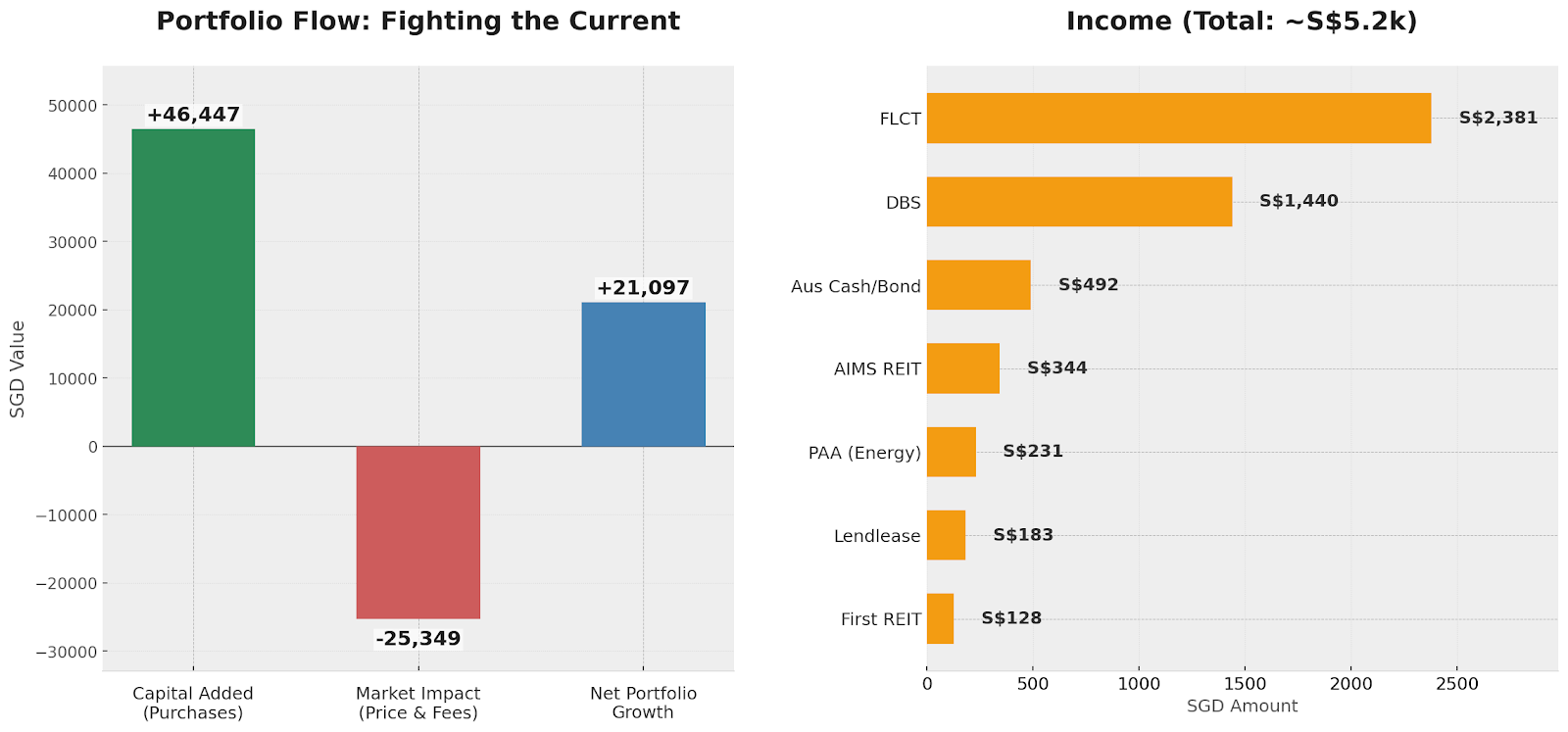
MTD return (excluding contributions)-0.89%Market Move/Starting Balance
Starting balance (1 Nov) S$2,848,958.7
Purchases S$46,446.6
Market move-S$25,349.2Includes trading fees
Dividends ReceivedS$5,172.3
Ending balance (30 Nov)S$2,870,056.1
Bridge Cash Bucket (BCB)S$150,000 (36% funded)
Dividend tapS$3,811.25/mth(76.23% of Target)
Total (Including BCB) S$3,020,056.1

Note: Dividend tap refers to the portfolio average monthly dividend which is estimated from Snowball Analytics.

November Portfolio Update

Purchases (1-30 Nov)

IWDA (Core): 90 shares @ 126.73 USD, approx S$15,284
IB01 (Defensive): 110 shares @118.10 USD, approx S$17,000
SGX:HMN (Country Tilts): 4300 shares @0.940 SGD, S$4,042
BTC (Alternatives): 0.085003  BTC, approx S$10,479

Total deployed: approx S$46,447

November 2025 Portfolio Update– Volatility on the Screen, Progress in the Plan

November looked dramatic on the charts but quite ordinary for the Atrahasis Portfolio. Stocks sold off, then snapped back. Tech sulked. Bitcoin threw a full‑on tantrum. Underneath all that noise, the portfolio quietly did what it’s built to do: collect income, lean into weakness, and keep risk spread across very different engines.

The backdrop: a V‑shaped month and a crypto tantrum

Global equities spent November zig‑zagging. Early in the month, markets were down roughly 4–5% from recent highs before staging a strong rebound into Thanksgiving. The S&P 500 and Dow ended the month with only marginal gains, while the Nasdaq actually finished about 1.5% lower as investors cooled on the frothier end of tech.

Beneath that, the narrative was all about interest rates. Expectations for a December Federal Reserve rate cut climbed sharply, and longer‑dated yields drifted lower again. That gave Treasuries their fourth straight month of gains and helped stabilise risk assets after the early wobble.

The real drama, though, came from Bitcoin. After hitting fresh highs earlier in the year, it fell more than 17% in November and briefly traded near a seven‑month low, making this its second‑worst month of 2025. Heavy ETF outflows and short‑term traders bailing out did most of the damage.

That backdrop matters because Atrahasis now holds a small, deliberate Bitcoin slice alongside its core of global stocks, bonds, REITs and cash.

Global stocks: still the core engine

I kept feeding the boring core.

My main global equity holding remains iShares Core MSCI World (IWDA), which tracks the MSCI World index across 23 developed markets. Over three small trades in November, I added 90 units of IWDA at prices around U$126.

These buys nudged the portfolio slightly closer to my 40% global equity target without trying to time anything fancy. Markets were wobbly when I added, which is exactly when it feels least comfortable to buy and most important to follow the plan.

IWDA remains the main “growth engine” of Atrahasis: hundreds of companies, across many countries, all bundled into one very boring, very useful ETF.

Bonds: the steady ballast

With sentiment swinging back and forth on interest rates, the safer side of the portfolio quietly did its job.

Singapore REITs & income: getting paid to wait

Singapore REITs have been slowly healing as rates stop marching higher and yields settle back into the mid‑5% range. They’re no longer market darlings, but that’s fine by me. At these levels, they’re back to doing what I want them to do: grind out income while I wait.

I also continued to build up my lodging and hospitality exposure. In November I added more CapitaLand Ascott Trust (HMN), turning it into a meaningful long‑term position in the income sleeve. The exact trade details sit in the transactions section above, but the spirit is simple: keep leaning into solid, diversified REITs when yields are still attractive.

November itself was a classic “pay month” for Singapore.
First REIT, Lendlease Global Commercial REIT, AIMS APAC REIT and Frasers Logistics & Commercial Trust all sent in distributions. DBS delivered the star payout with S$1,440 of dividends on its own. Together, the REITs plus DBS added about S$4,500 of fresh cash to the portfolio.

Overseas, my US energy pipeline holding PAA chipped in as well, paying about US$170 before withholding tax. The Australian income stream continued too, with my AUD cash and bond sleeve generating another chunk of interest.

All in, November’s income engine provided roughly S$4.5k, A$560 and US$170 in gross distributions across the portfolio. For a month where prices mostly wobbled sideways, that’s a nice reminder of why I like having an income spine running through Atrahasis. Those cashflows can either be redirected into whatever’s cheap, or used to quietly bulk up the safer sleeves without me having to inject new money every time.

The plan here hasn’t changed: keep REITs and dividend stocks at sensible weights, let them do the heavy lifting on income, and use their payouts to rebalance into weakness rather than chase whatever happens to be hot.

    Bitcoin: leaning into discomfort

    Bitcoin had a rough month, dropping sharply from recent highs as ETF flows cooled and fast money headed for the exit. For most people, that kind of move feels scary. For my tiny allocation, it was simply a live test of whether I’d actually follow my rules.

    Instead of reacting to the noise, I stuck to the script. I made a series of very small buys spread across the month, adding about 0.085 BTC in total — roughly US$7,800 of new capital at the time. No heroics. No “all‑in on the dip.” Just steady dollar‑cost averaging into a pre‑defined, capped risk bucket.

    If Bitcoin keeps sliding, the position will stay small relative to the overall portfolio and I’ll keep accumulating at better prices within that budget. If it recovers, these uncomfortable buys will have done their job. Either way, the key is that this slice is sized so it cannot sink the ship.

    How it all fit together

    On paper, November won’t go down as a spectacular month for the Atrahasis Portfolio. Global stocks were roughly flat, tech was a little soft, bonds were gently positive, and Bitcoin was sharply down. The end result felt more like a sideways walk than a sprint.

    Behaviour‑wise, though, it was an important month:

    • Equities: I kept feeding the global core through IWDA top‑ups, instead of trying to outguess the next headline.

    • Bonds & cash: Short‑dated Treasuries and cash remained the quiet grown‑ups in the room, keeping overall volatility in check while still earning something.

    • REITs & dividends: Singapore REITs, DBS and overseas holdings combined to throw off around S$4.5k, A$560 and US$170 in income, which now sits ready to be redeployed.

    • Bitcoin: The newest, noisiest member of my Alternatives sleeve reminded me why position sizing and rules matter more than bravado or vibes.

    Put differently: when one risky sleeve (Bitcoin) went through a proper drawdown, other parts of the portfolio (short‑dated bonds, cash, income REITs, DBS) quietly absorbed the drama. That’s exactly the trade‑off I signed up for when I chose a diversified, income‑friendly structure instead of a pure‑equity rocket ship.

    Looking ahead to year‑end

    Going into December, the playbook stays boring on purpose:

    • Keep funnelling fresh cash into IWDA as the long‑term growth core.

    • Maintain a solid bond and cash cushion via short‑dated Treasuries and the AUD cash sleeve.

    • Gradually build Singapore REIT and dividend positions while yields remain interesting.

    • Treat Bitcoin as a tiny, volatile satellite governed by rules and sizing, not emotion.

    In a month where headlines shouted about corrections, valuations and crypto drama, the Atrahasis Portfolio mostly just stuck to its script: collect income, rebalance on dips, and let time do the heavy lifting.

    I Let an AI Audit My Supplement Stack. It Found Problems I’d Ignored for Years.

    Disclaimer: I am a blogger, not a doctor. The following article details a personal experiment using Artificial Intelligence to review my health habits. This information is for educational and entertainment purposes only and does not constitute medical advice. Never stop, start, or change the dosage of prescription medications (such as statins) or supplements without consulting a qualified healthcare professional. Interactions can be complex and individual.

    Introduction

    I sometimes scroll the Chrome Discover feed on my phone, and a few days ago, while scrolling, I caught a reference to a new study published in late 2025 in Cell: Comprehensive human proteome profiles across a 50-year lifespan reveal aging trajectories and signatures.

    I managed to get my hands on the full text of the paper and the findings were fascinating. Researchers had mapped how the human proteome (the entire set of proteins expressed by our genome) shifts over five decades. The takeaway wasn't just that we age; it’s that aging is biological, measurable, and systematic.

    Even more striking were the inflection points: specific milestones: clustered around ages 45 and 60, where the body undergoes rapid molecular shifts, rather than just a slow, steady slide. Seeing the number 45 resonated deeply, as it is uncomfortably close to my own age.

    I put down my phone and looked at the side of my workdesk where I keep my supplements. Sitting there was my chaotic "supplement graveyard",  a cluster of bottles I’ve accumulated over the last few years. A multivitamin here, a heart-health pill there, something a podcast recommended in 2022.

    The contrast was jarring. Science is measuring aging with molecular precision, and I’m combating it by randomly popping pills whenever I remember to, usually right before brushing my teeth.

    I realized I needed a second opinion. Not just a Google search, but an audit. Since the new Gemini 3 Pro had just launched with rave reviews for its reasoning capabilities, I decided to hire it as my temporary, unpaid biological consultant to perform a limited AI health audit.

    I wanted to know: Is my routine actually supporting my longevity, or am I just making expensive urine? And, true to the spirit of Atra-Hasis, how does extending my "healthspan" change the math of my financial independence?

    Here is what happened when I let an AI take apart my daily supplement routine.

    Asset Allocation Strategy

    Some of the supplements i take daily

    From Proteome Papers to Pill Bottles

    I uploaded the full PDF of the Cell paper to Gemini. I started our session by asking it to synthesize the findings and apply them to my context.

    "Based on what we know about proteomic aging trajectories from the paper," I asked, "what are the low-hanging fruits for me to incorporate into my supplement strategy?" 

    Gemini’s synthesis was sharper than I expected. It focused heavily on maintenance and highlighted a key concept from the paper: the "Senohub."

    The study identified the Aorta (the main artery) as a tissue that ages earliest and acts as a "Senohub," spreading inflammatory signals to other organs. This made the AI's lifestyle recommendations hit harder:

    • Zone 2 Cardio: Not just for "fitness," but specifically to maintain vascular elasticity and delay the aorta's transition into a senescence generator.
    • Blood Pressure Control: The silent killer of longevity.
    • Heat Shock Proteins: Via sauna use, to aid protein folding (highly relevant to a paper on the proteome).
    • Nutrient Timing: Not just what you eat, but when.

    I was already doing the cardio (and counting my scalding hot showers as "heat exposure"). But the "timing" point stuck out. That’s when I decided to bare my soul (and my medicine cabinet) to the machine.

    The Sleep Sabotage

    The first thing Gemini flagged was the timing of the multivitamin and my Ginkgo supplement.

    "You are taking a high-potency B-Complex (included in your multivitamin) and a cerebral stimulant (Ginkgo) right before attempting to enter deep sleep," it noted. "B-vitamins are co-factors in energy production, and Ginkgo Biloba can increase alertness and cerebral blood flow. While they don't have caffeine, they are biologically stimulating and could be interfering with your sleep architecture."

    I paused. I had been struggling with waking up groggy recently, despite getting "enough" hours. I had assumed it was stress or too much screentime. I never considered that my "health" habit was keeping my brain buzzing at 11:00 PM.

    Gemini advised shifting both the multivitamin and the Ginkgo to breakfast or lunch immediately.

    The Statin, CoQ10, and BioPerine Triangle

    Then we got into the more delicate territory: my prescription statin and how it fits with my supplements. This was where the AI impressed me by spotting issues a human might miss.

    I take Rosuvastatin daily. It is well-documented that statins can deplete the body's natural levels of CoQ10, which is why I supplement it. 

    Here’s the issue: the CoQ10 product I take also contains BioPerine (piperine), a black pepper extract that’s marketed as an “absorption enhancer.”

    Gemini pointed out that piperine has been shown in some studies to affect how the body handles certain drugs and nutrients, by influencing enzymes and transporters involved in metabolism and absorption. The human evidence at typical supplement doses is limited and often theoretical, but it was enough to raise a simple question:

    If I don’t need to take my statin at the exact same moment as an absorption enhancer, why create extra uncertainty?

    Rosuvastatin is less dependent on some of the classic pathways people worry about (for example, it relies less on CYP3A4 than statins like simvastatin), and I didn’t find strong evidence that my specific combo is dangerous. Still, the overall message I took away was: when you’re combining prescription meds with “bioavailability boosters,” it’s reasonable to be cautious and to loop in a doctor or pharmacist.

    So here’s the personal experiment I landed on, not a general recommendation:

    1. CoQ10 (with food) in the morning or lunch. (CoQ10 is fat-soluble and gives energy, which was another reason not to take it at night).
    2. Rosuvastatin in the evening.

    Gemini also nudged me to look into Ubiquinol (the reduced form of CoQ10), which may be better absorbed as people age. That’s something I’ll discuss with my doctor before switching, rather than just swapping capsules on my own.

    None of this is medical advice. It’s simply how I used AI to surface a potential interaction, then chose a conservative timing change while I seek a professional opinion.

    Redesigning the Stack and the Process

    I didn't just take the Gemini's word for it. I spent the next evening cross-referencing its claims against reputable medical sites and also its cousin ChatGPT 5.1 Pro.

    The verdict? It was mostly right. B-vitamins and Ginkgo could disrupt sleep. CoQ10 is better taken with fat in the morning. And spacing out absorption enhancers from prescription meds is just good hygiene.

    I rebuilt my protocol from first principles:

    1. Morning (breakfast): Life Extension Multivitamin + CoQ10 + Omega-3s + Ginkgo biloba. (Fuel for the day, and keeping things simple).
    2. Pre-Bed: Magnesium Glycinate (supports relaxation) + Rosuvastatin.

    The Early Results

    I’ve been on this AI-audited routine for a few days now, and the difference isn't a placebo.

    My Apple Watch (using the AutoSleep app) tracks my sleep, and for the last three nights, I have exceeded 3 hours of Deep Sleep. Before this, I struggled to get past 1.5 hours.

    Of course, I need more data to confirm the trend, but the contrast is there. I’m no longer waking up feeling like I spent the night solving algebra equations, and my routine finally feels intentional.

    How to Use AI for Your Own Health (Without Being Reckless)

    If you want to perform this limited AI health audit yourself, do not treat Gemini or ChatGPT as a doctor. Treat them as a research assistant who has read every abstract but has zero clinical experience.

    What to Provide the AI

    To get good results, you need to be radically specific:

    • The Full List: Every supplement, brand, and dosage. A picture of the back of the supplement bottle, showing its ingredients, is also good.
    • Prescriptions: List everything and dosages.
    • Timing: When do you take them?
    • Goals: "I want to improve energy," or "I want to lower inflammation."
    • Biomarkers: If you have recent blood work (cholesterol, Vitamin D levels), reference it.

    Good Ways to Use AI

    • "Check for Interactions": Ask it to cross-reference your list for drug-nutrient or nutrient-nutrient interactions.
    • "Audit for Timing": Ask what time of day is optimal for absorption and sleep.
    • "Identify Redundancies": Ask if you are double-dosing on anything (e.g., getting Zinc from both a multi and a ZMA supplement).

    The Pitfalls

    • Hallucinations: AI can invent studies. Always ask for sources or verify claims via Google/PubMed.
    • Nuance Blindness: AI tends to be generic. It doesn't know your liver function or genetic history unless you tell it.
    • The "More is Better" Trap: AI might suggest adding things. Be skeptical. Subtraction is often the best medicine.

    Longevity, Healthspan, and Financial Planning

    Why am I writing about CoQ10 interactions on a finance blog?

    Because Atra-Hasis is about the systems that sustain us. We spend thousands of hours optimizing our asset allocation, tweaking our Safe Withdrawal Rates (SWR), and minimizing tax drag.

    But biological aging is the ultimate "inflation." It erodes your most valuable asset: your ability to enjoy the wealth you're building.

    If I successfully extend my healthspan, e.g. if I am hiking at 80 instead of sitting in a chair, that changes my financial plan fundamentally:

    1. The Time Horizon: My portfolio might need to last for 40 years of retirement or more, not 30. That might require lowering my SWR from 3.25%.
    2. Healthcare Costs: The most expensive years are the final ones. A healthier 80-year-old might spend less on chronic care but needs a larger buffer for a longer, fuller life.
    3. Human Capital: Improved health means I have the option to work longer on projects I love, reducing sequence-of-returns risk.

    Using AI to audit my health is exactly like using a Monte Carlo simulation to audit my portfolio. It’s about finding the weak points, checking the correlations (interactions), and optimizing for durability.

    Conclusion

    Gemini 3 Pro didn't save my life, but it arguably improved my nights. It acted as a mirror, showing me that my "health routine" had become a mindless habit rather than a strategic protocol.

    We are entering an era where we can have a hyper-intelligent co-pilot for our biology. It’s on us to use it wisely, to ask the right questions, fact-check the answers, and realize that staying healthy is the longest-term investment we’ll ever make.

    Audit your stack. Check your timing. And sleep well.

    The 3-Bucket Sanity Check: Why My “Broken” Portfolio is Actually Fine

    If you compared the Atrahasis Portfolio to its own allocation rules this month, you would probably tell me to panic.

    My rules-based Asset Allocation Strategy states that 40% of my investable portfolio should be in a Global Core ETF (IWDA). In reality? Inside my main brokerage account, it is sitting at a measly 9.9%.

    My strategy also limits "Country Tilts" (bets on specific regions like Singapore, Australia, or the US) to 10%. In reality? That bucket has swollen to 41.1%.

    By any traditional definition, my portfolio is broken. A robo-advisor would be flashing red warning lights, screaming at me to sell my individual stocks and buy the core.

    But I am not selling. Not yet.

    Why? Because while the micro view is messy, the macro view provides a crucial "Sanity Check" that tells me everything is going according to plan. This is especially true when we view it through the lens of Benjamin Graham, the father of value investing and author of The Intelligent Investor.

    Asset Allocation Strategy

    The Optical Illusion of Failure (The Micro View)

    When we zoom in on the specific "Sleeves" of the Atrahasis portfolio, the drift in the portfolio looks undeniable.

    Current vs target (23 Nov 2025)

    SleeveTarget %Current %Current Δ %
    Global Core (IWDA)409.9–30.1
    Global
    Factor Tilts
    712.29+5.4
    EM ex China65.1–0.9
    Country Tilts1041.1+31.1
    Defensive2215.9–6.1
    Alternatives1210.2–1.8
    AUD FX35.4+2.4

    Graham liked to personify the market as a moody business partner ("Mr. Market") who shows up every day with a quote but never forces you to trade. My sleeve-level “red cells” are just Mr. Market shouting prices at me. The only question that matters is whether my overall policy still makes sense.

    The culprit here is not just "Home Bias." Yes, my Singapore positions (DBS, REITs) are heavy. However, the real "bloat" in my Country Tilt bucket comes from a legacy collection of individual stocks from my active trading days.

    Defensive vs. Enterprising Remnants Looking at this through Graham’s lens, my portfolio is split between a Defensive Core and the leftovers of my old speculative era.

    • The Defensive Engine: IWDA, the factor ETFs, and my REITs. This is the future: minimal fuss, market-like returns.
    • The Enterprising Junkyard: The legacy US single stocks. This is what is left of my stock-picking experiment, now running off in a strictly capped corner of the portfolio.
    Proof I’m Not a Hoarder

    It is easy to say "I will sell eventually." It is harder to actually do it. But looking at my transaction logs, I have already been aggressively cleaning house:

    • Nov 2024: I sold my entire stake of Palantir (PLTR), capturing the massive run-up and exiting the position entirely.
    • May 2021: I sold all my Nvidia (NVDA) shares (pre-splits). While I missed the later AI boom, I stuck to my discipline and took my chips off the table.
    • Dec 2020: I exited Zscaler (ZS) completely, selling into strength to simplify the portfolio.

    I am not blindly holding "forever." I am actively pruning. What remains today is just the "Stubborn Tail": high conviction keepers like Shell and bagholders like Lemonade that I am waiting to break even on.

    The Reality of Risk (The Macro View)

    So, why am I not panic-selling everything today? Because investing is about managing risk in layers.

    When I zoom out to the "3 Buckets" view and include my BCB (Bridge Cash Bucket), which is the liquidity I hold outside the main brokerage, the picture flips.

    Target Allocation (3 Buckets) 23 Nov

    BucketComponentsTarget AllocationCurrent Allocation (w/ BCB)
    EquitiesCore + Factor + EM + Country
    63%63.5%
    Fixed Income, Defensive & Liquidity
    Bonds + AUD FX + BCB25%26.1%
    Alternatives
    Gold + Crypto (BTC, ETH)12%10.4%

    Note: The "Current Allocation" column includes my Bridge Cash Bucket which brings the Fixed Income bucket back to target. Functionally, this BCB is my buffer against the "Sequence of Returns" risk that Bill Bengen highlighted, acting as a bridge so I am never forced to sell equities at a loss during a brutal early-retirement bear market.

    At this level, the portfolio is not broken; it is solid. Graham’s guideline for a defensive investor was simple: keep your stock allocation somewhere between 25% and 75% of your wealth. At roughly 63.5%, I am comfortably inside that sane band.

    The issue is not that I am wildly overexposed to stocks; it is that too much of that equity exposure is sitting in concentrated US names rather than broad, tax-efficient ETFs. This is mainly a Concentration Problem, not a total risk problem.

    The Plan for 2026: The "Situs" Watchlist

    While I am calm about the allocation, I am less calm about the tax risk.

    Many of my legacy positions are US-listed (Micron, Lemonade, Plains All American). For a Singaporean investor with no US estate tax treaty, holding more than $60,000 in US-situs assets brings my estate into the US estate tax regime.

    This is not a hard "cliff" where I lose everything, but it is a threshold where the pain begins. Any value above U$60,000 is taxed at graduated rates starting from 26% and rising to 40%.

    I calculated my exact exposure this morning using the current rate (1 USD ≈ 1.308 SGD), and the numbers are tight.

    Current US Situs Watchlist

    TickerAssetValue (USD)Status
    SHELShell (UK, ADR)~$45,358Keep (Dividend)
    LMNDLemonade~$23,536Sell & Rebalance to Core
    MUMicron~$14,494Keep
    PAAPlains All Am.~$7,643Keep (Dividend)
    CPNGCoupang~$5,590Sell & Rebalance to Core
    OthersPFE, ZROZ, etc.~$6,687Sell & Rebalance to Core
    TotalPure US Assets¬$57,950⚠️ HEADROOM: $2,050

    Note: Shell is a UK-incorporated company held via a NYSE-listed ADR. Current US tax guidance generally treats ADRs of foreign corporations as non-US-situs assets, so Shell likely doesn't count toward the $60k limit. I still include it in my calculations because tax law is complicated.

    My "Pure US" exposure (US-incorporated companies and US-domiciled ETFs) is about U$57,950.

    That leaves roughly $2,050 of headroom. A single good day for Lemonade could push me over the line. While crossing $60k isn't fatal as I would only pay tax on the excess amount, it still creates a tax filing headache and a liability I simply don't want.

    My 2-Step Fix

    1. The "Flow" Fix (For Allocation) The default destination for fresh cash is IWDA and other non-US-situs, Irish-domiciled ETFs. While I still have specific rules to top up Bitcoin or REITs if conditions are right, the heavy lifting of my monthly inflows is now dedicated to the Core. Over time, the Global Core sleeve rises, and the relative weight of the legacy US stock bucket shrinks.

    2. The "Cap" Fix (For Situs Risk) I am treating the US stock sleeve as a "Run-Off" book, but I’m not panic-selling.

    • Growth Trap Exits: If speculative names like LMND ever claw their way back to break-even, I will sell them. That capital will be recycled into Irish-domiciled ETFs (like IWDA) that are generally outside the scope of US estate tax.
    • The Soft Limit (U$60k - U$100k): Since the Estate Tax is graduated (starting at ~26% on amounts over U$60k), crossing the line slightly isn't a disaster. If a rally pushes me into this zone, I will accelerate trimming my "Sell List" stocks like Lemonade and Coupang opportunistically, rather than waiting for a perfect break-even price.
    • The Hard Limit (U$100k): This is the real danger zone. At $100k of US assets, the estate tax liability jumps to over U$10,000 which is a cost I am not willing to bear. If I approach this level, I will be forced to trim even "Keeper" stocks like Micron immediately to get back to safety.

    A Note on "Break-Even": Yes, waiting for "break-even" before selling is technically irrational; the market does not care what my entry price was. I treat this as a behavioral hack: it keeps me emotionally calm while I slowly run off the speculative tail, and I accept that I might leave a bit of expected return on the table in exchange for actually sticking to the plan.

    Conclusion

    If you find yourself staring at a red cell in your spreadsheet and feeling the urge to sell, zoom out.

    My portfolio looks "broken" at the sleeve level, but it remains solid at the bucket level. The easy clean-up work is done. Now, I am executing a disciplined "Run-Off" strategy: diluting the legacy positions with fresh inflows and trimming the weaker US stocks over time, without rushing for the exit just because the margin is tight.

    Disclaimer: None of this is tax or investment advice, just my personal framework as of late 2025. I am not a financial advisor. Please talk to a qualified professional before you copy any of it.